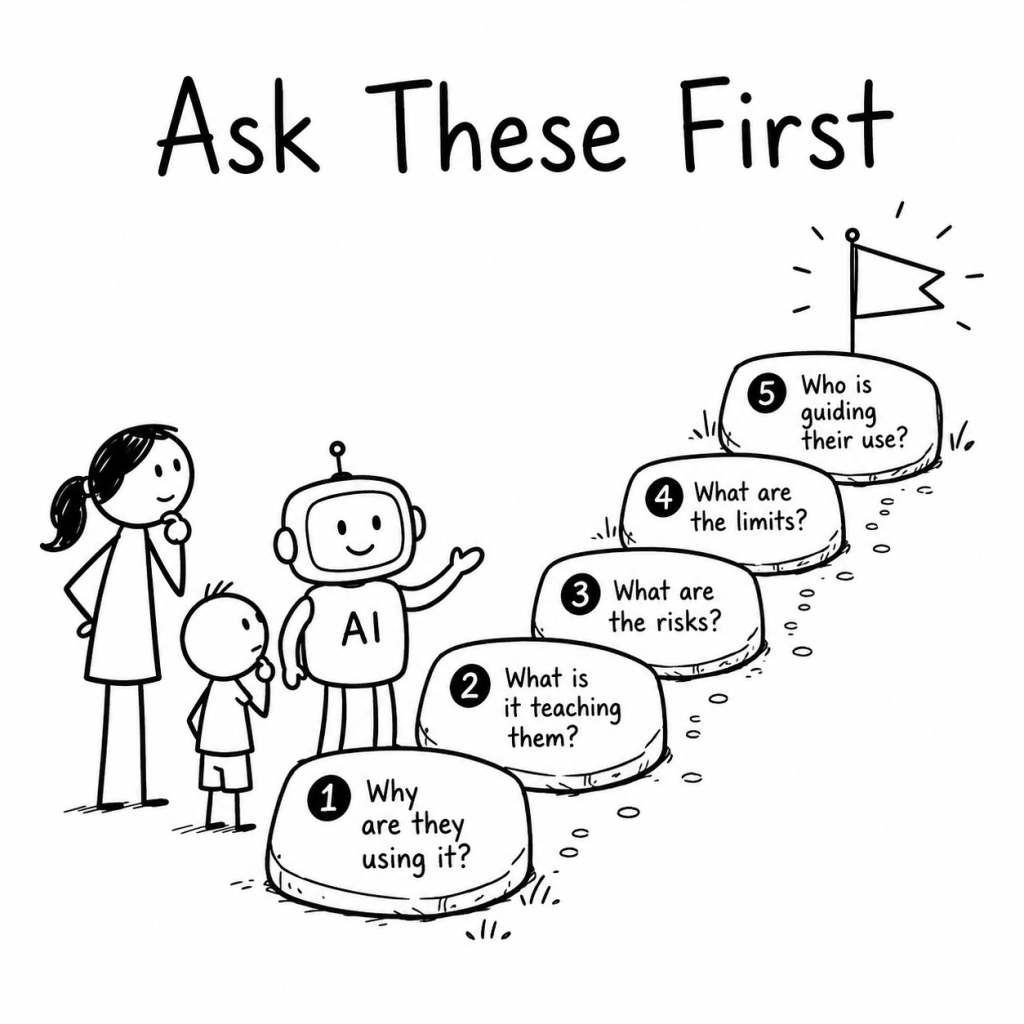
The hardest part of parenting around AI is that the same tool can help a child think or help them avoid thinking.
It can explain a difficult idea, ask practice questions and help a child explore possibilities. It can also produce the answer, finish the homework and make something look complete before the child has made a meaningful decision.
That is why “Should children use AI?” is too broad to be useful.
A better question is:
What is the child still doing while AI is open?
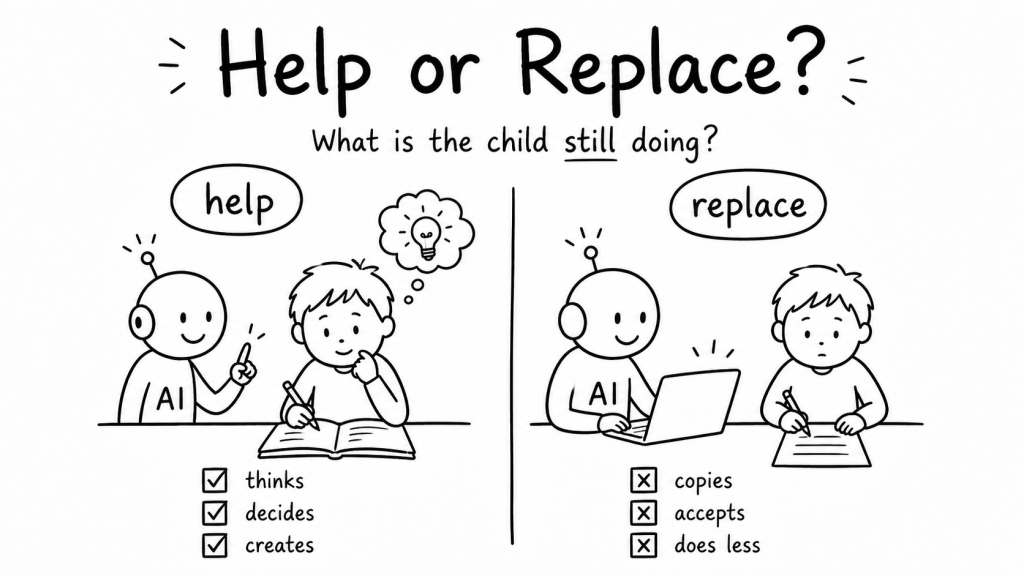
As a parent and software engineer, I do not think the useful choice is “AI or no AI.” The more practical choice is between AI that supports thinking and AI that replaces it.
The following five questions turn that principle into something a family can actually use.
In this guide
1. Will AI make children lazy?
AI does not automatically make a child lazy. But it can remove the effort that a particular task was meant to develop.
Suppose a child asks AI to explain why the sky changes colour at sunset. The tool may help them understand a difficult idea. Now suppose the child asks it to write the explanation, copies the result and submits it. The finished page may look similar, but the learning process is completely different.
The distinction is not simply whether AI was used. It is whether the child still had to notice, choose, connect or explain.
A useful test: After using AI, can the child explain the idea without looking at the AI response?
If the answer is no, the tool may have completed the task without building much understanding.
2. Should children use AI for homework?
Yes, in some situations. But AI should act more like a coach than a ghostwriter.
A coach helps the learner perform the work. A ghostwriter performs the work for them.
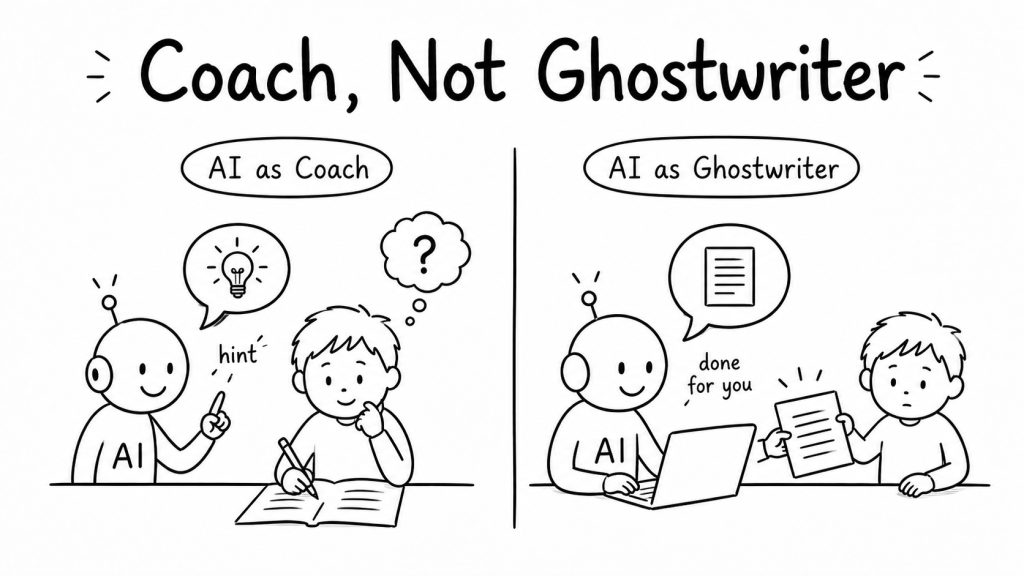
AI as a coach
- Explain this idea in simpler words.
- Give me one hint, not the answer.
- Ask me questions to check what I understand.
- Review my answer and show me where my reasoning is weak.
- Give me another example so I can practise.
AI as a ghostwriter
- Write my answer.
- Complete the worksheet.
- Make the project look finished.
- Rewrite this so nobody can tell I did not understand it.
The boundary will vary with the child, the subject and the purpose of the assignment. A spelling exercise and a research project do not require the same kind of effort. The parent’s job is not to ban assistance. It is to protect the part of the task where learning is supposed to happen.
This connects with a related idea I explored in Use AI to learn faster: the pause before an answer often contains the effort we should be careful not to remove.
3. Will AI weaken creativity?
It can weaken creativity when it makes the interesting decisions before the child does.
Creativity is not only producing a polished picture, story or presentation. It includes choosing a direction, rejecting an obvious idea, combining unrelated things and deciding what feels worth making.
AI can support that process by offering possibilities. But the child should still shape the result.
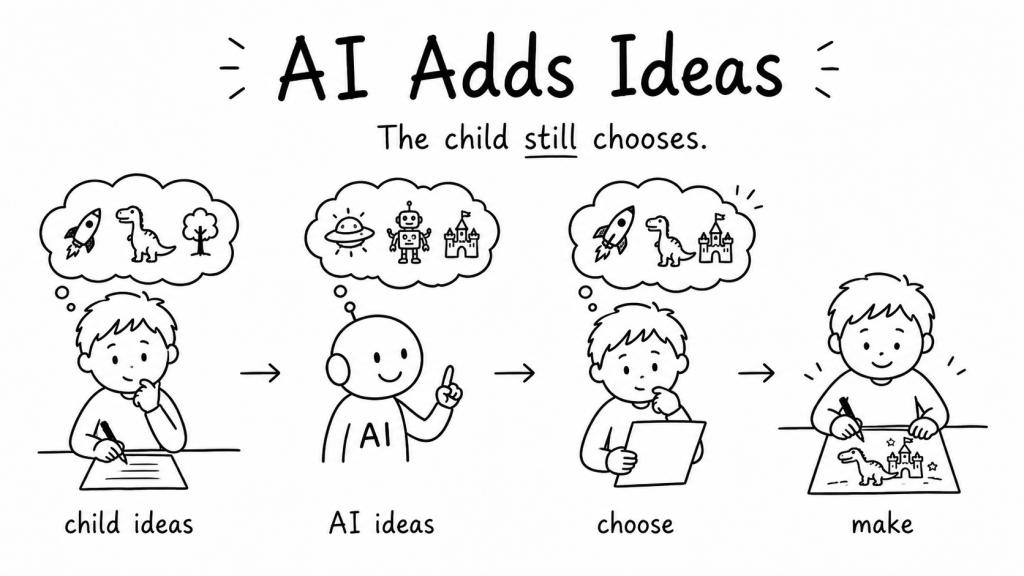
Try this sequence:
- The child creates three ideas first.
- AI contributes three more possibilities.
- The child compares, combines or rejects them.
- The child makes the final version.
In that sequence, AI expands the option space. It does not own the creative direction.
4. Is AI safe for children?
There is no universal yes-or-no answer because AI tools differ, children differ and the context matters.
UNICEF’s current guidance on AI and children highlights safety, privacy, transparency, inclusion, well-being and preparation for an AI-shaped future. UNESCO’s guidance for generative AI in education also emphasises data privacy, age-appropriate use and human oversight.
For a parent, those broad principles can become a short checklist:
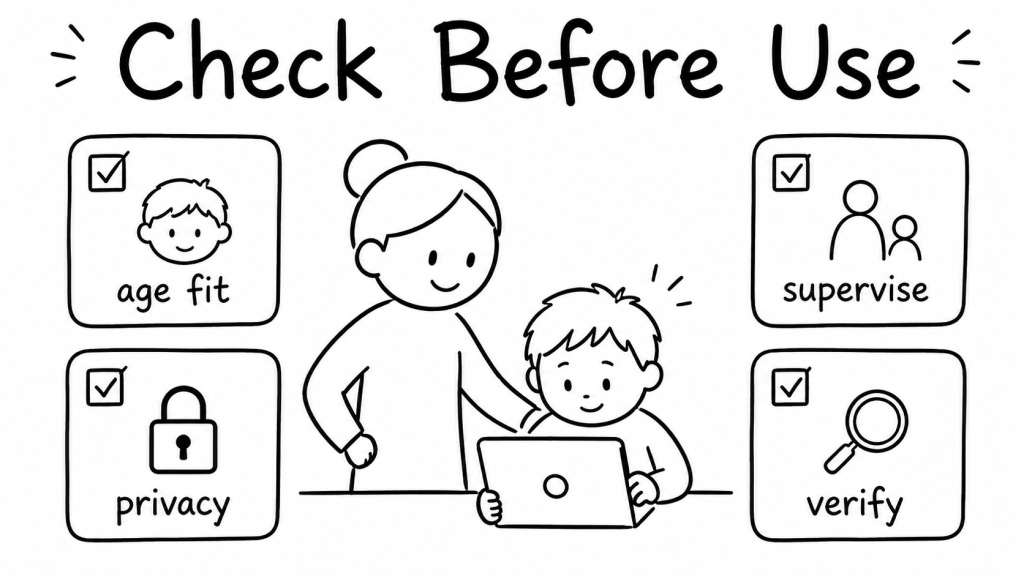
- Age fit: Check the tool’s minimum-age rules and whether independent use is appropriate for this child.
- Privacy: Avoid sharing a child’s full name, school, address, private photos, health details or other sensitive information.
- Supervision: Younger children benefit from using AI with an adult nearby rather than treating the tool as a private authority.
- Accuracy: Teach children that a confident answer can still be wrong, incomplete or biased.
- Emotional boundaries: AI should not quietly become the only place a child turns for personal guidance or reassurance.
The goal is not to make a child frightened of the technology. It is to help them recognise that helpful language on a screen is not the same as judgment, responsibility or care.
5. How much AI is too much?
Minutes alone will not answer this.
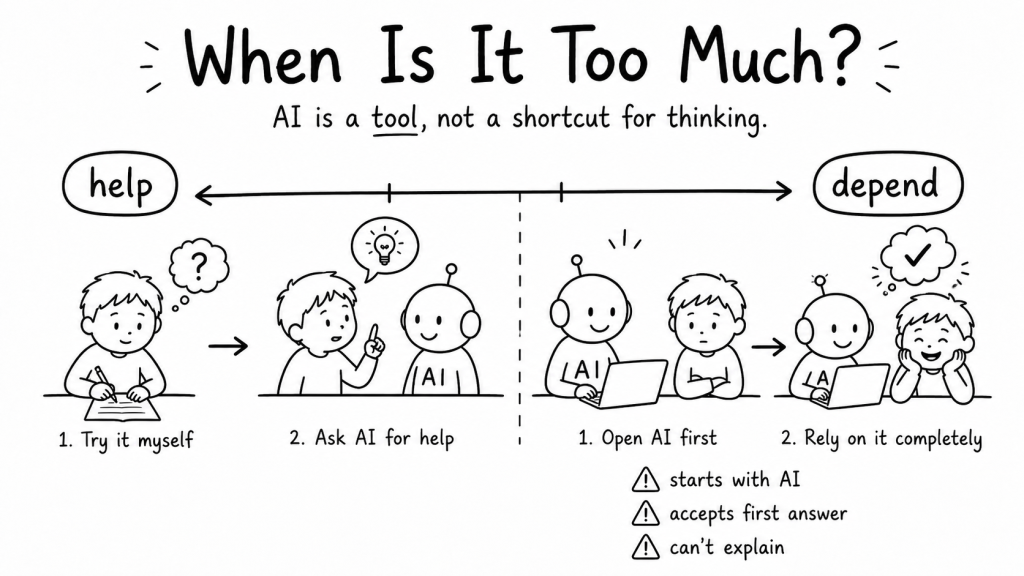
Ten minutes of copying may remove more learning than thirty minutes of questioning, testing and revising. The better measure is not only time. It is dependency.

AI use may be becoming excessive when a child:
- opens the tool before trying anything independently
- accepts the first response without checking it
- cannot explain what they submitted
- feels unable to begin without AI
- uses AI to avoid every moment of confusion or difficulty
Confusion is not always a problem to eliminate. Sometimes it is the beginning of learning.
A better parent rule: Think, Create, Question
Instead of creating a complicated family policy for every possible AI tool, start with three questions:
Did my child think?
Did my child create?
Did my child question?
“Think” means the child made connections, attempted an answer or explained some reasoning.
“Create” means the child made meaningful choices rather than simply accepting a generated result.
“Question” means the child checked, challenged or improved what the tool produced.
This rule is not a scientific measurement. It is a practical decision aid. It changes the conversation from “Was AI used?” to “What kind of participation did AI leave for the child?”
A small family experiment
For one week, do not begin by limiting AI with a fixed number of minutes. Instead, choose one AI-assisted activity and use this sequence:
- Before AI: Ask the child to make a first attempt, prediction or idea.
- With AI: Use the tool for explanation, questions, feedback or alternatives.
- After AI: Ask the child to explain what changed in their thinking.
You are not trying to catch the child using AI incorrectly. You are helping them notice the difference between receiving an answer and developing an idea.
The tool is not the final test
Children will grow up with AI woven into school, work and everyday decisions. Avoiding every use is unlikely to prepare them well. Accepting every use will not prepare them either.
The more durable skill is learning when to accept help, when to struggle a little longer and when to question the answer in front of them.
So the next time AI appears in homework or creative play, the first question does not need to be, “How do I stop this?”
Ask whether the child is still thinking, creating and questioning.
That is a clearer line than fear. It is also a skill the child can eventually learn to apply without us.
Continue exploring
- How to Use AI Without Letting It Do Your Child’s Thinking
- Can Your Child Explain the Answer Without AI?
- How to Teach Children Not to Trust Every AI Answer
- A Five-Minute AI Answer Check for Families
- What Should Children Keep Practising When AI Can Produce the Answer?
- How to Prepare Children for an AI-Shaped Future
Visit the Start Here guide for a path based on the question your family is facing.
Questions parents often ask
At what age should a child start using AI?
There is no single age that fits every tool or child. Check the tool’s minimum-age rules, consider the child’s ability to question an answer and begin with adult supervision rather than independent use.
Is using AI for homework cheating?
It depends on what AI does and what the assignment is meant to practise. Asking for an explanation, hint or feedback can support learning. Asking AI to produce the answer and submitting it as the child’s work removes the intended effort.
How can I tell whether AI helped my child learn?
Close the AI response and ask the child to explain the idea, show the reasoning or apply it to a new example. If they cannot, the tool may have produced a result without building understanding.
How much AI use is too much?
Dependency is often a better signal than minutes. Watch for a child opening AI before trying, accepting the first answer, being unable to explain the result or feeling unable to begin without the tool.
What should a parent ask after a child uses AI?
Ask, “What changed in your thinking?” Then ask whether the child thought, created and questioned while using the tool.


Leave a comment