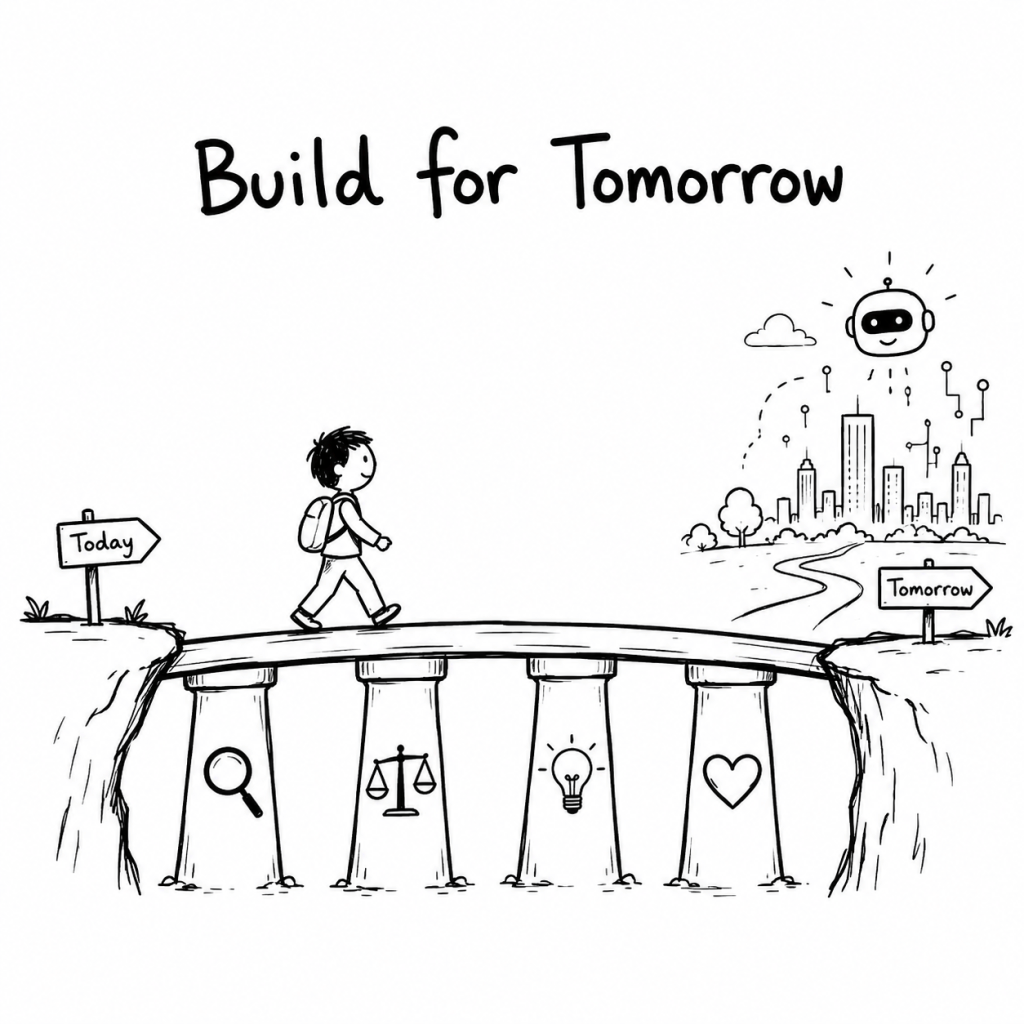
We cannot future-proof a child by guessing which job will be safe. We can help them practise how to learn, judge and create as tools change.
Advice about children and AI often arrives as a prediction. Learn this tool. Prepare for that career. Start at this exact age.
The problem is that tools change, interests develop and children do not move through readiness on one fixed timetable.
A more useful approach is to build adaptable practices. These practices help children work with new tools while keeping curiosity, judgment and ownership in the process.
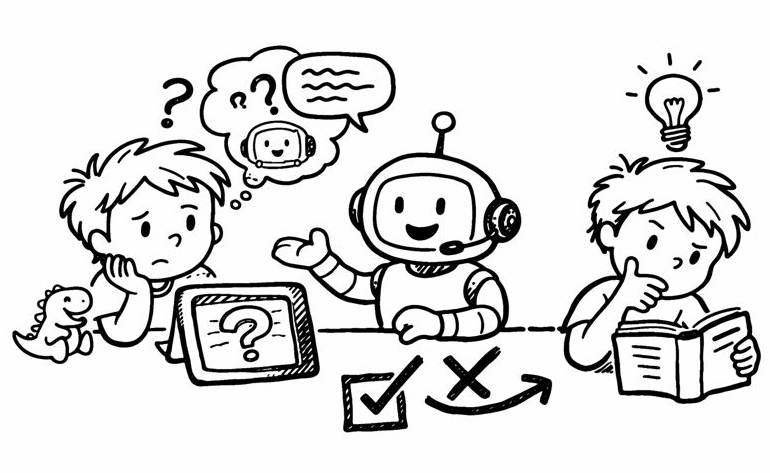
Prepare the learner, not a prediction of the future.
Use the Explore, Question, Create, Verify, Decide framework
1. Explore possibilities
AI can widen the range of ideas a child encounters. It can suggest project topics, explain unfamiliar fields, invent examples and show several ways to approach a problem.
Use that breadth to support curiosity, not to prescribe an identity.
- “What else could we try?”
- “What kind of person works on this problem?”
- “Which part sounds interesting enough to explore further?”
A child does not need to choose a future career during an AI conversation. They need permission to notice interests and follow useful questions.
2. Question the answer and the problem
Children need practice questioning both what AI produces and what they asked it to solve.
- What problem are we actually trying to solve?
- What is the answer assuming?
- What information is missing?
- Who might see this differently?
This habit matters because a polished answer to the wrong question is still unhelpful.
It also protects curiosity. The child remains someone who investigates rather than someone who waits for a machine to finish the thought.
3. Create something the child owns
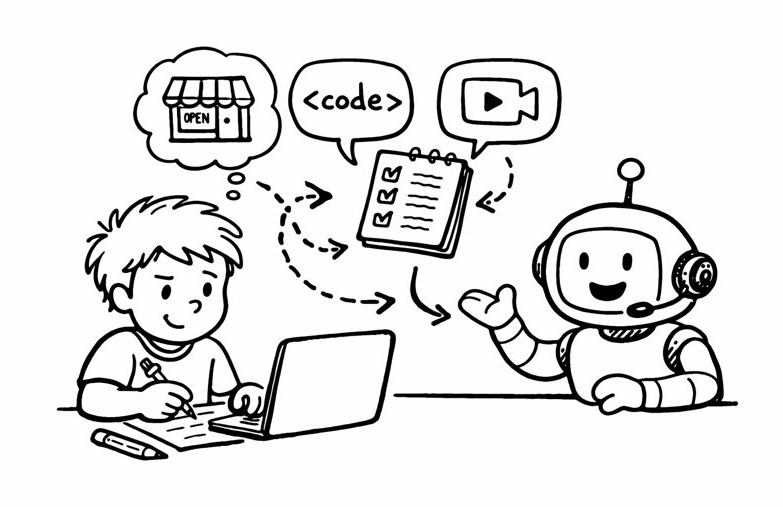
Move beyond using AI only for answers. Use it as material for a story, model, experiment, game, presentation, drawing or small solution.
Ownership remains with the child when they make meaningful choices:
- They choose the goal.
- They make a first attempt.
- They decide which suggestions to keep.
- They edit, test and finish the work.
- They can explain why the final version looks the way it does.
AI can assist with planning and drafting. The child should still shape the direction and take responsibility for the result.
This is the difference between screen time that merely produces content and screen time that builds agency. See what a screen may be teaching a child.
4. Verify important claims
Children should learn that confidence, detail and fluent language are not evidence.
When an answer includes an important fact, ask the child to identify the claim, find a suitable independent source and explain what the evidence supports.
The level of checking should match the cost of being wrong. A playful idea needs little verification. School research, health information and consequential decisions need much more.
Use the Pause, Question, Check, Compare and Explain framework for a complete family routine.
5. Decide with judgment and values
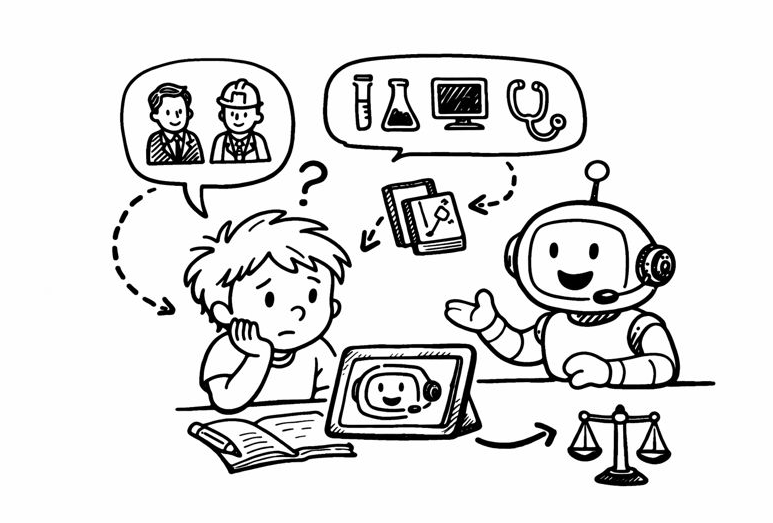
AI can list options. It cannot take responsibility for what a child values, what tradeoff is acceptable or which direction feels worth pursuing.
Give children opportunities to decide:
- Which idea fits the goal?
- What are we giving up by choosing it?
- Who might be affected?
- What would make this choice fair, honest or useful?
- What would you choose without the AI suggestion?
Judgment develops through choices followed by reflection. It cannot be outsourced and then recovered at the end.
Adapt the framework to readiness, not a rigid age chart
The following are adaptable examples, not developmental rules.
For children using AI with an adult
Keep the activity shared and concrete. Invent a story together, sketch an animal the AI described or compare its answer with a book. The adult controls the tool and the child contributes questions and choices.
As independence grows
Ask for a first attempt before AI. Compare two answers. Check one important fact. Build a small project and ask the child to explain what they changed.
For teenagers working on real projects
Make the process visible. Keep notes on prompts, sources, decisions, revisions and tests. Discuss privacy, attribution, consequences and when human expertise is necessary.
The same teenager may need close support in one domain and considerable independence in another. Readiness depends on the task, stakes and child.
Try one complete project loop
Choose a project small enough to complete this week. It might be a family quiz, a short story, a simple game, a model, a mini research question or a plan for improving something at home.
- Explore: Generate several possibilities.
- Question: Define the problem and assumptions.
- Create: Make a first version the child directs.
- Verify: Check important facts and test the result.
- Decide: Choose what to change, keep or remove.
Finish with three questions:
- What did AI help you do?
- What did you decide yourself?
- What can you explain or demonstrate without the tool?
The last question connects the project to the explain-back test. It also reinforces the practices in what children should keep practising when AI can produce the answer.
The future will keep changing. A child who can explore, question, create, verify and decide has a way to keep learning through that change.
Part of the ThinkBySketch parent guide.
Read Should Children Use AI? or choose a path in Start Here.


Leave a comment