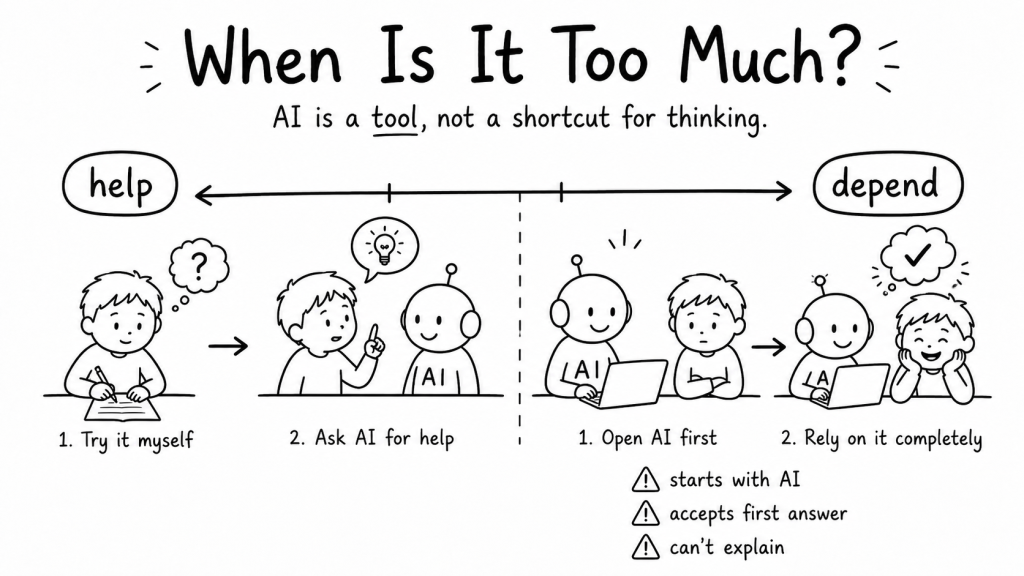
Before deciding whether a child should use AI for a task, ask what the child still needs to practise.
This five-question check helps parents distinguish useful support from AI that quietly completes the learning.
The five-question check
- Has the child tried first?
A first attempt can be an answer, prediction, sketch, plan or question. It does not need to be correct. - Will AI explain or complete?
Explanation, hints and feedback support the learner. Producing the final answer often removes the intended practice. - Will the child make meaningful choices?
The child should still choose the direction, examples, argument, design or final version. - Can the child check the result?
The child should compare sources, test a claim or recognise when adult help is needed. - Can the child explain it afterward?
Close the AI response and ask the child to explain what changed in their thinking.
Print the family card
Keep the five questions near the homework desk or use them before an AI-assisted activity.
Count the “yes” answers
4 or 5 yes answers
AI is likely supporting the learning.
The child still attempts, decides, checks and explains.
2 or 3 yes answers
Use AI with stronger boundaries.
Ask for one hint, require a first attempt or add an explain-back step.
0 or 1 yes answer
Let the child try independently first.
AI is probably removing most of the thinking the task was meant to develop.
This is not a scientific assessment. It is a practical conversation tool. A spelling exercise, emotional question and open-ended project need different boundaries.
Three prompts that preserve effort
Give me one hint without giving me the answer.
Ask me questions that help me find the weak part of my reasoning.
Review my first attempt and suggest one thing I should improve myself.
Think. Create. Question.
The goal is not to catch children using AI incorrectly. It is to help them notice the difference between receiving an answer and developing an idea.
Get the Think by Sketch Parent Toolkit
Subscribe and I’ll email you three practical printables: the Family AI Starter Kit, 7 AI Activities to Do Together and the Meaningful Screen Time Toolkit. You’ll also get one useful visual idea each week.
Check your inbox and confirm your subscription. I’ll send the toolkit immediately after confirmation.
 ThinkBySketch