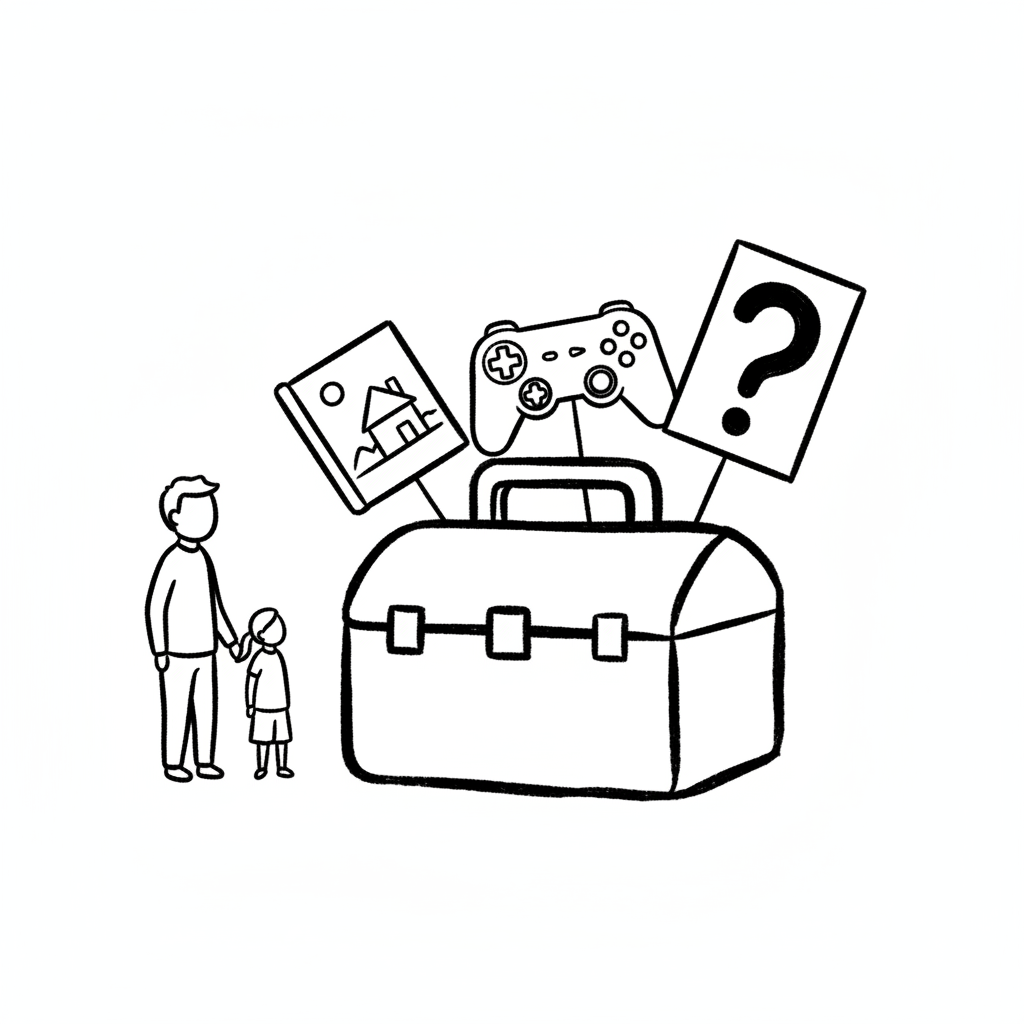
You don’t need another list of parenting rules. You need something useful at the moment a real decision comes up.
Your child wants to try a game. An AI tool offers to do the homework. Reading together starts feeling like a target to finish. Pick the resource that fits your situation and use only what helps.
Everything on this page is free. No email address is required. These are conversation aids and small experiments, not guarantees about what works for every child.
Before a new Roblox game: check what the controls actually do
A setting can help limit access to certain experiences, people or purchases. It can’t replace the conversation about what your child should do if an interaction feels wrong.
Roblox Family Setup — 7 checks + 3 questions
When to use it: Before your child starts Roblox or asks for a new experience.
Review seven account settings, then agree on three simple family questions. The guide includes current Roblox documentation, a worked six-page parent playbook and a one-page quick reference.
Download the illustrated Roblox parent playbook (6 pages) →
Prefer a one-page Roblox quick card? Download it here (PDF) →
Before AI helps with homework: protect the important thinking
AI giving a useful hint and AI completing the child’s work are different kinds of help. The practical first question is: What is this task meant to help my child practise?
Family AI Check — five questions
When to use it: When your child wants AI to help with writing, maths or a project.
A five-question check with worked homework examples, adult-operated AI prompts, troubleshooting scripts and a family agreement.
Download the illustrated Family AI playbook (5 pages) →
Prefer a one-page Family AI quick card? Download it here (PDF) →
When screen-time debates go in circles: change the question
Two equal-length sessions can look very different: playing creatively with a friend versus watching a feed without a clear stopping point. A useful conversation asks what happened on the screen—and what it displaced.
Meaningful Screen Time Toolkit (PDF)
When to use it: When you’re reviewing what screen time means in your own family.
A practical illustrated playbook with a 15-minute observation, a seven-day family reset, transition scripts and a reusable tracker.
Prefer a one-page screen-time quick card? Download it here (PDF) →
For wider context, the American Academy of Pediatrics offers a family media plan designed around your family’s routines and priorities.
Tonight, try a reading game that needs no app
The prediction swap: Read a story together for a few minutes. Before turning a page, ask each other to predict what happens next. Each of you gives one reason. Turn the page, laugh if you were wrong, then ask what clue you missed. That’s the entire activity.
If your child isn’t in the mood for reading, stop. It’s an invitation to notice stories, not another assessment to complete. Explore the ThinkBySketch reading story →
Share a resource, not a lecture
If another parent is wrestling with the same decision, send them the specific guide or printable—not necessarily the whole website. They can try one small idea and decide what fits their family.
Share on WhatsApp → · Share by email →
Find your question on Start Here → · Why ThinkBySketch exists →
Created from a parent-and-engineer perspective, not as clinical or educational professional advice. Platform settings change; the Roblox guide links to current official documentation. The printable resources are free and do not require a subscription.

