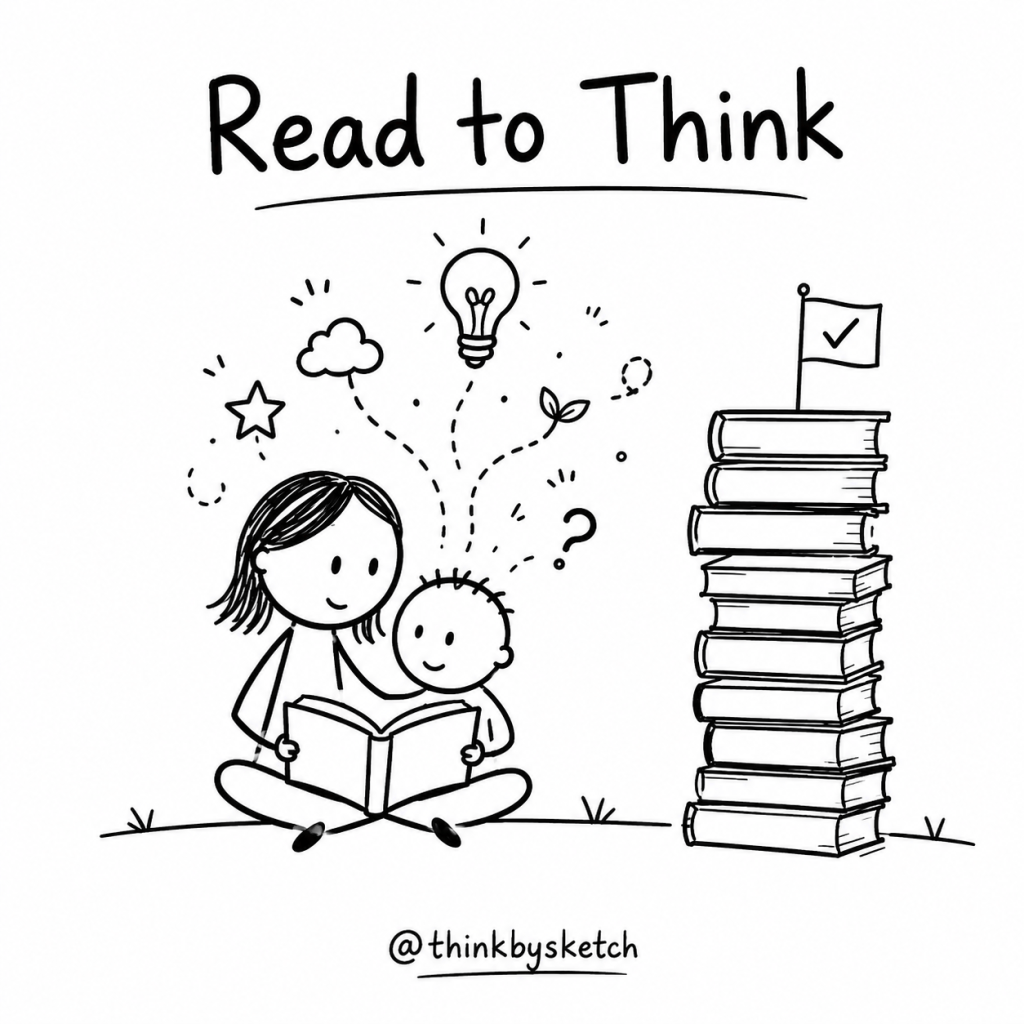
A child can finish a book without thinking much about it.
Another child can read three pages and spend twenty minutes wondering, predicting and arguing with the author.
Which one had the richer learning experience?
Reading matters, but the number of pages is only one part of the story. The deeper opportunity is what the child does with the ideas.
A book can become a thinking space
Stories and information texts give children material to examine from a safe distance.
They can ask why a character made a choice. They can notice what information is missing. They can compare a new idea with something they already know.
These actions make reading active:
- Predict what may happen next.
- Explain why a character behaved that way.
- Find a clue that supports an interpretation.
- Imagine a different solution.
- Connect the story to another book or experience.
- Question whether the narrator is reliable.
The goal is not to turn every bedtime story into a lesson. It is to make room for curiosity when it naturally appears.
Do not test the child after every page
Questions can deepen reading. Too many questions can make it feel like an examination.
Instead of checking whether the child remembers the “right” detail, use open prompts:
- “What surprised you?”
- “What do you think this character has misunderstood?”
- “Which part would you draw?”
- “What would you ask the author?”
- “Did this remind you of anything?”
A good question does not prove that the child was paying attention. It gives them another way to enter the idea.
Let children see adults reading for a reason
Children often hear that reading is important without seeing how adults use it.
Make the purpose visible:
- Read instructions to repair something.
- Compare two explanations before making a decision.
- Look up a question that appeared during dinner.
- Read a story because you enjoy the language or characters.
This shows that reading is not only a school activity. It is a tool for solving, exploring and enjoying.
Start smaller than a reading target
A large target can turn reading into another task to complete. Start with a repeatable moment instead.
Try ten quiet minutes, one short chapter or a single illustrated article.
Stop while the experience still feels manageable. A child can return tomorrow with some curiosity left.
A simple read, sketch and explain experiment
After reading a small section, ask the child to sketch one of these:
- The most important moment
- A confusing part
- A cause-and-effect chain
- A different ending
Then ask them to explain the sketch.
The drawing does not need to be beautiful. It helps make the child’s interpretation visible, which gives the conversation somewhere concrete to begin.
A useful reading habit is not measured only by how much a child consumes.
It is also visible in the questions, connections and explanations that remain after the page is closed.
 ThinkBySketch
Leave a comment