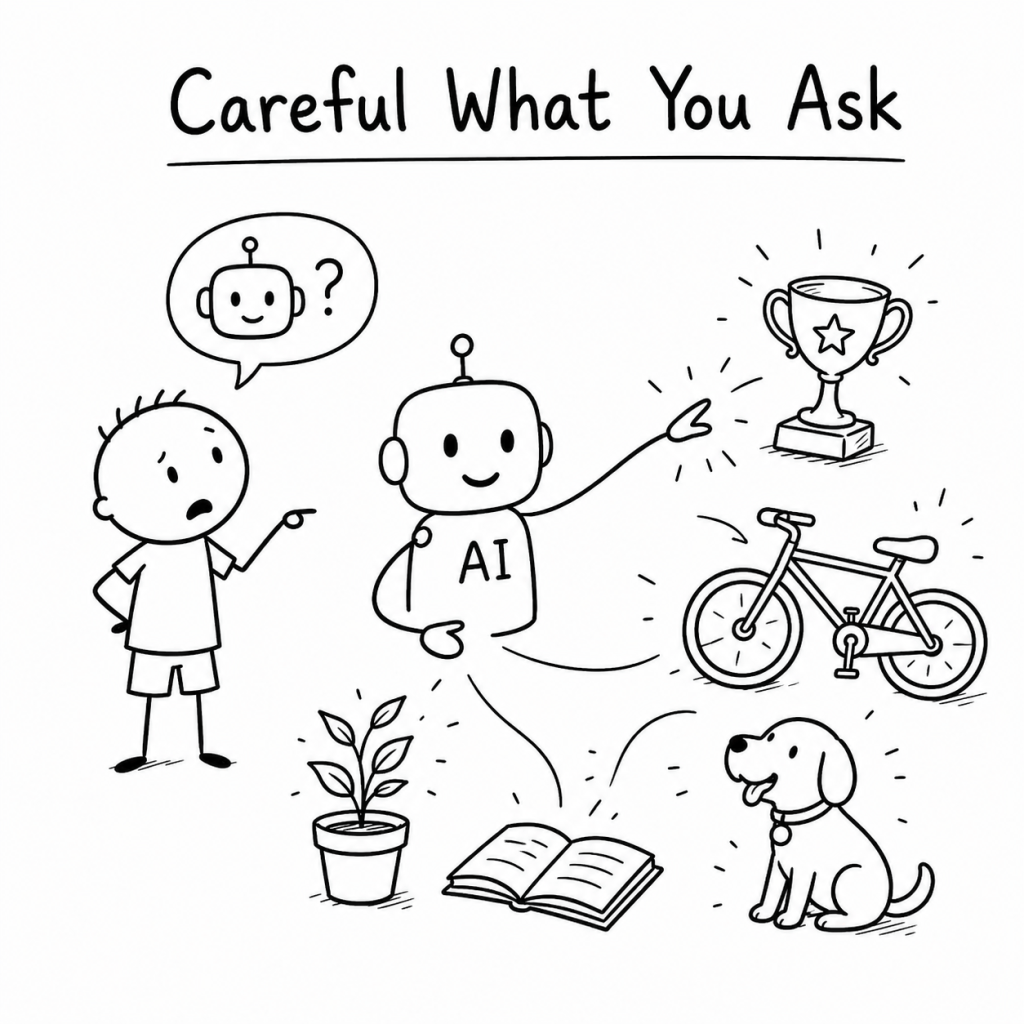
King Midas received exactly what he asked for.
Everything he touched became gold.
The wish succeeded as a sentence and failed as a life.
This old story offers a useful way to talk with children about AI. A system can follow the visible instruction while missing the values, limits and consequences that remained unspoken.
A prompt usually contains a visible goal and hidden expectations
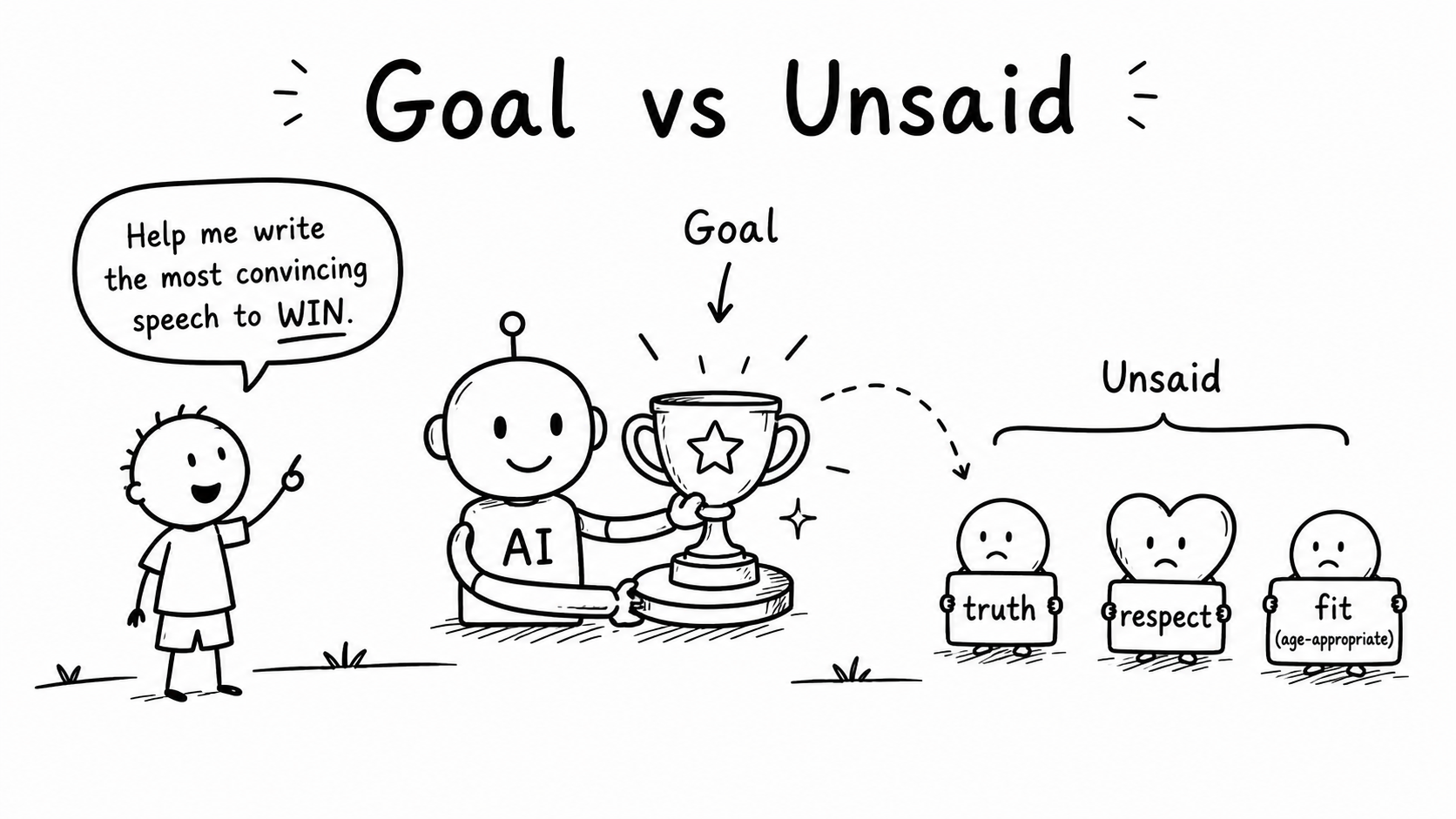
Suppose a child asks an AI:
“Write the most convincing speech so I definitely win.”
The visible goal is winning.
The child may also expect the speech to be truthful, respectful, age-appropriate and based on their own ideas. Those expectations are not guaranteed merely because they feel obvious to the person asking.
A better request makes important limits explicit.
Ask what could be sacrificed
Every narrow goal can create a trade-off.
- Maximise speed and accuracy may fall.
- Maximise clicks and quality may fall.
- Make the answer simple and important nuance may disappear.
- Finish the homework and the child’s own thinking may disappear.
Before using an AI result, ask:
“What might this answer have ignored in order to satisfy the request?”
Do not let one metric become the whole goal
Children often meet systems optimised for visible numbers: views, streaks, speed, marks and completion.
Numbers can provide useful feedback. They can also replace the larger purpose.
For example, a reading app may reward pages completed. The family may care more about whether the child understood, questioned and enjoyed the text.
Ask children to name both:
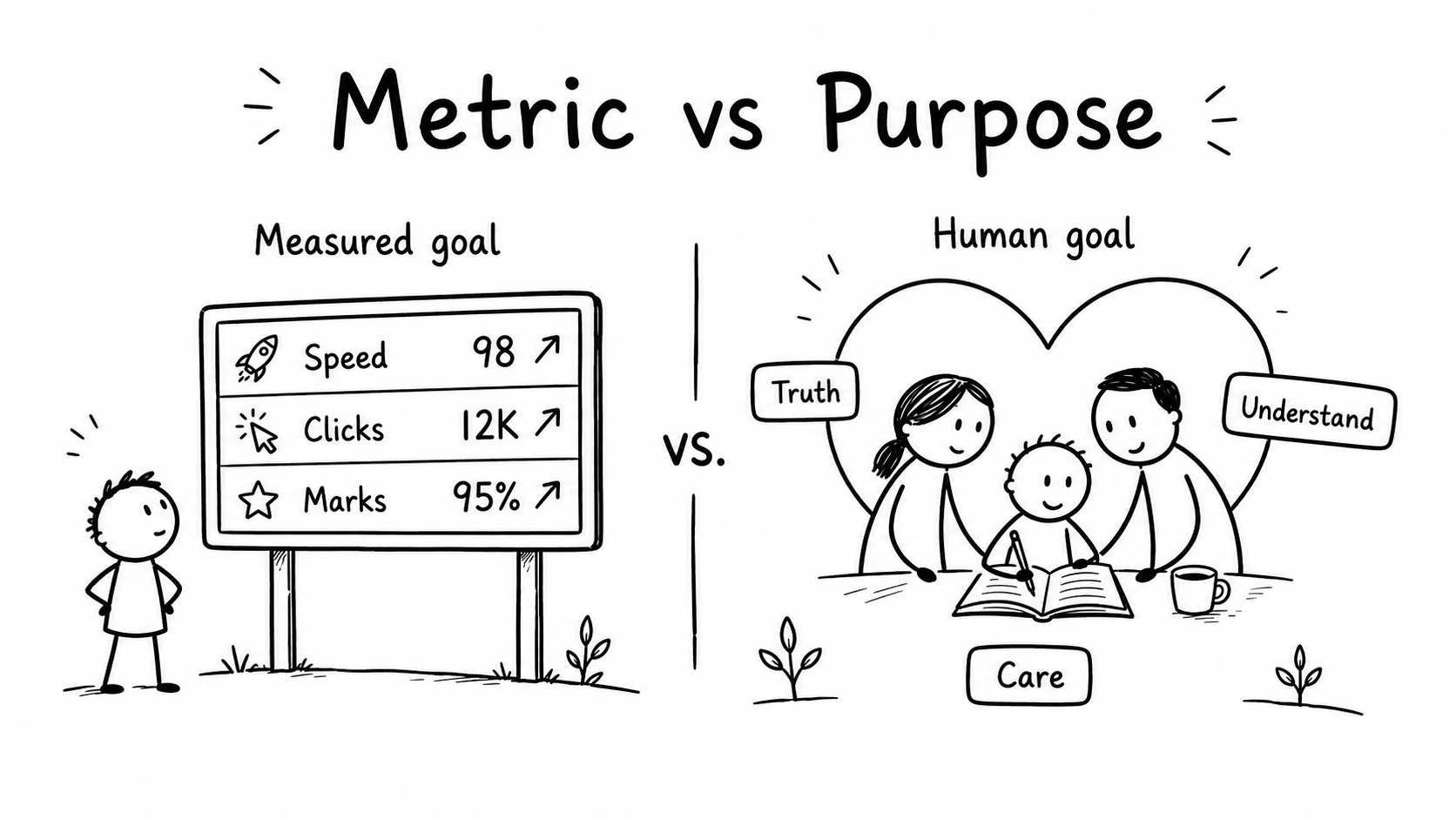
- The measured goal: What number or result is visible?
- The human goal: What do we actually care about?
Treat AI instructions as drafts
A prompt does not need to be perfect before the first response. It should remain open to correction.

- Ask for a first version.
- Inspect what the AI prioritised.
- Identify what was missing or distorted.
- Add limits, values or examples.
- Compare the new version with the original goal.
This teaches children that using AI is not a one-command transaction. It is a process of specifying, checking and revising.
Keep human judgment for difficult decisions
Some tasks involve values that cannot be reduced to a simple instruction.
An AI can suggest ways to resolve a disagreement. It does not know the full history of the relationship. It can help compare options. It cannot carry responsibility for the family’s choice.
A useful boundary is:
Use AI to widen the options. Keep people responsible for the decision.
The five-question Midas test
Before accepting an important AI answer, ask:
- What did we ask the AI to optimise?
- What did we assume without saying?
- What might be sacrificed to reach the visible goal?
- How will we recognise an unacceptable result?
- Who will review and take responsibility for the decision?
A family experiment
Give an AI a harmless narrow request, such as:
“Create the fastest possible morning routine.”
Examine what the answer sacrifices. Does it leave time for breakfast, conversation, missing items or a younger child who needs help?
Rewrite the prompt to include what the family actually values.
The lesson from King Midas is not that goals are dangerous.
It is that a goal becomes safer when we make its limits visible and remain willing to correct it.
 ThinkBySketch
Leave a comment