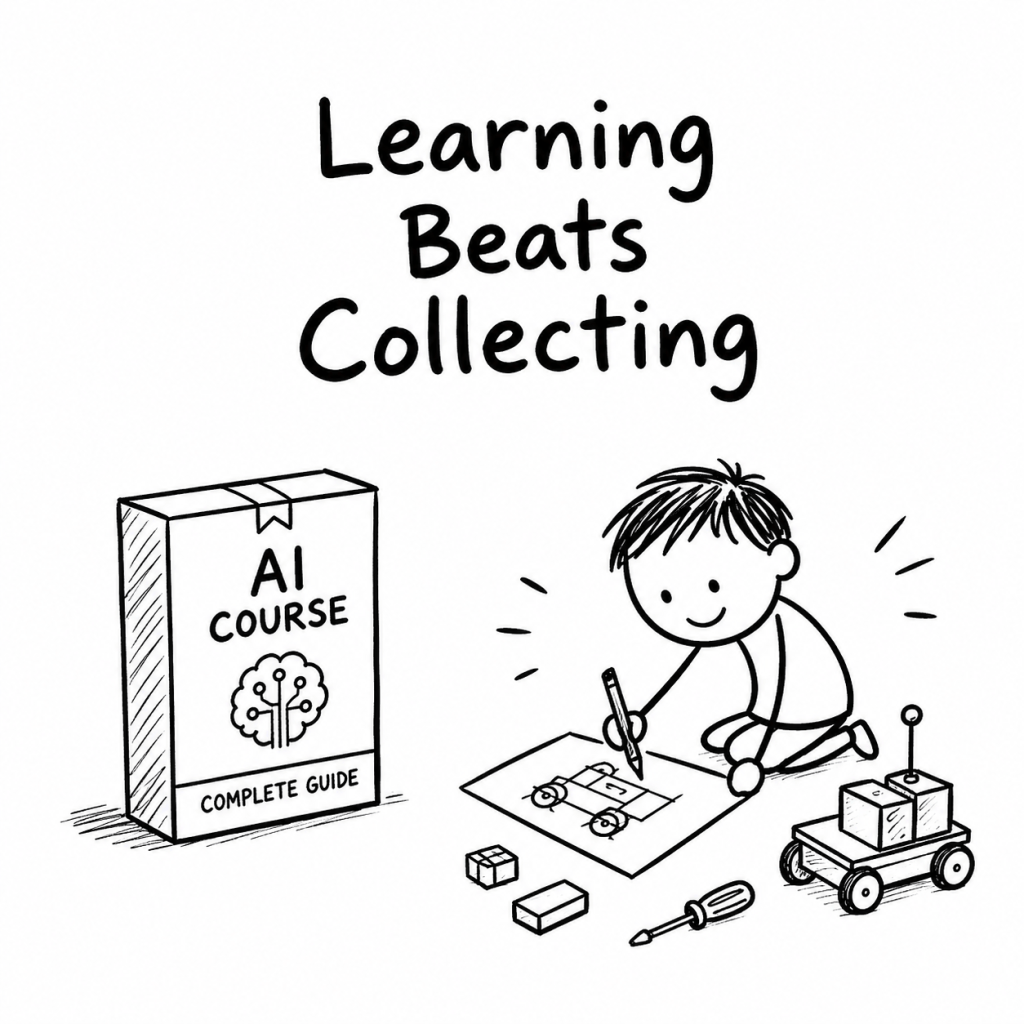
My team members were taking AI courses, sharing certificates and talking about the modules they had finished.
I bought one too.
Then I did not open it.
For a while, the unopened course felt like evidence that I was falling behind. The tools were changing quickly. New learning paths kept appearing. Other people seemed to have a plan.
But I kept building small products.
A feature would fail. A design would feel wrong. A technical question would block the next step.
Then I would learn what the problem demanded.
I had bought a learning path before finding a learning reason
Courses can be useful. Structure can reduce confusion. A good teacher can help a learner avoid unnecessary mistakes.
The problem was not the course.
It was that the course was not connected to a question I urgently wanted to answer.
I had purchased the feeling of progress before deciding what progress meant.
Building gave the knowledge somewhere to go
Learning through a project was uneven. It did not follow a clean sequence. I sometimes discovered a gap only after something failed.
But the knowledge stayed connected to a decision:
- Why did this feature fail?
- What is confusing about this design?
- Which tool fits the problem?
- What should I test next?
The project did not make formal learning unnecessary. It gave me a better filter for choosing it.
A course becomes more useful when it answers a question that is already alive.
Children are often given lessons before a reason to care
Adults choose the worksheet, app, lesson and sequence. Then we sometimes interpret low interest as a problem inside the child.
Another possibility is that the activity answers a question the adult selected, not one the child is trying to solve.
A child who wants to build a paper bridge may suddenly care about weight, balance and shape. A child making a small game may become curious about logic, numbers and language.
The project creates a reason for the lesson.
Curiosity is a doorway, not a complete curriculum
Children should not learn only what feels immediately interesting.
Some foundations need repeated practice. Some ideas become enjoyable only after the child gains enough skill to use them. Adults still provide structure, boundaries and broader exposure.
Curiosity can still help us choose where to enter.
Instead of asking only, “What should this child learn next?” we can also ask:
“What are they trying to make, understand or solve?”
The answer may lead to the same subject. The difference is that the child now has a reason to enter it.
A small experiment for parents
Before choosing the next learning resource, ask the child:
“What is something you wish you could make or understand right now?”
Then look for the knowledge hidden inside the answer.
- What foundation does the project require?
- What can the child attempt before instruction?
- Which resource would answer the next real question?
- How will the child use what they learn?
The project does not have to replace the lesson plan.
It may reveal the doorway into it.
What the unopened tab changed
I may still open the course.
I no longer see the closed tab as proof that I am lazy or behind.
It reminded me that learning becomes more meaningful when knowledge has somewhere to go.
Mine was telling me to build something.
So I did.
 ThinkBySketch
Leave a comment