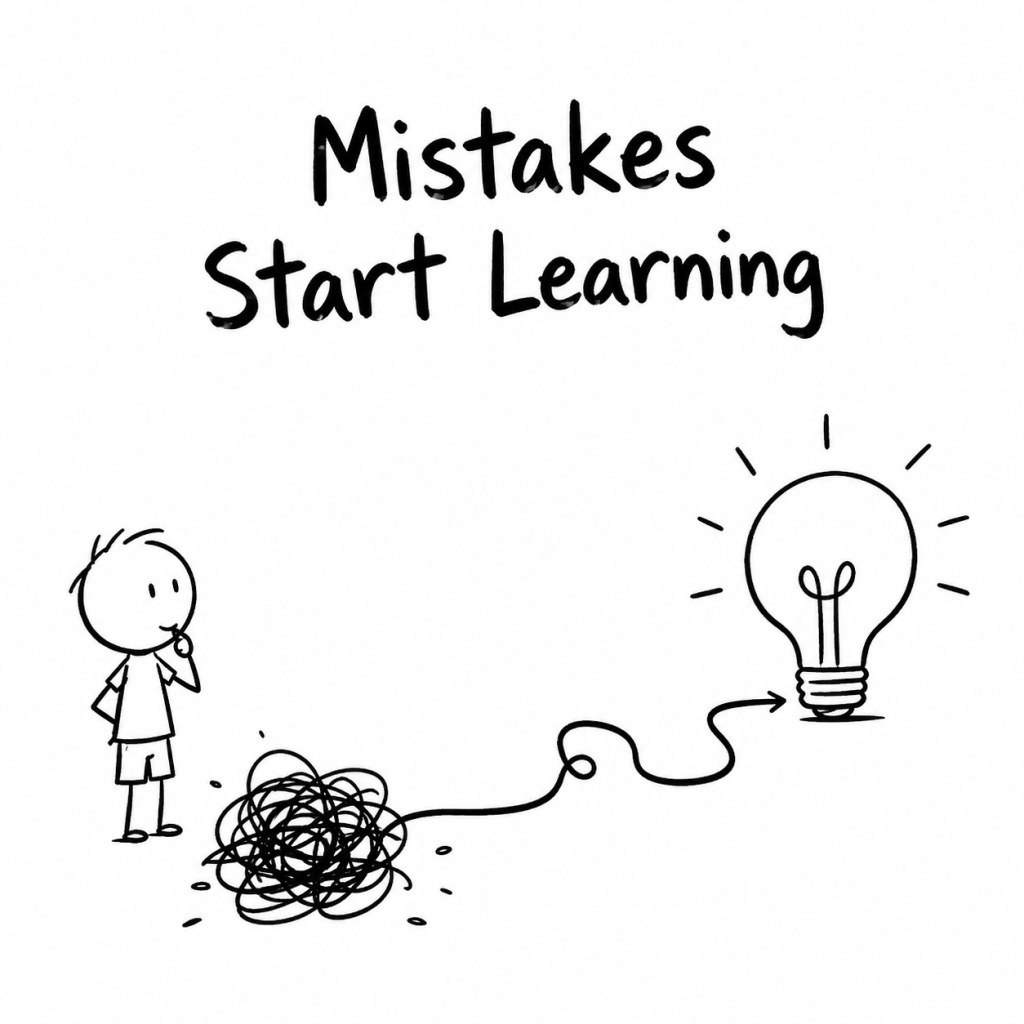
A correct answer tells you that a child arrived. A mistake shows you the road they took.
When a child gets something wrong, our instinct is often to replace the mistake with the right answer as quickly as possible.
That can fix the page without fixing the thinking.
A mistake is useful because it reveals the child’s current model. It shows which idea they understood, which connection is missing and where an explanation should begin.

Do not begin with the explanation you prepared. Begin with the idea the child already has.
Why correcting too quickly can hide the real problem
Imagine a child says that heavier objects fall faster than lighter objects.
You could immediately say, “That is incorrect.” The child may remember the correction long enough to repeat it. But you still do not know why the original idea felt reasonable.
Perhaps they have watched a stone and a leaf fall. Perhaps they are mixing weight with air resistance. Perhaps the word “faster” means something different to them.
The mistake is not an obstacle before the lesson. It is the map for the lesson.
Use this five-step explanation method
1. Notice the exact mistake
Listen for the specific claim rather than labelling the whole answer as wrong.
Instead of “You do not understand fractions,” notice: “You treated the larger denominator as the larger value.”

2. Ask how the child arrived there
Use a neutral question:
“Can you show me what you were thinking?”
This is not a test. It is an invitation to reveal the steps. The child may have used a sensible rule in the wrong place. That is more useful than simply hearing the answer again.
3. Contrast the two ideas
Place the child’s model beside a contrasting example.
For fractions, draw one pizza cut into three pieces and another cut into eight. Ask which single slice is larger. The contrast lets the child inspect the rule rather than accept a correction.

4. Rebuild the explanation together
Now connect the new idea to something the child already understands.
You might say, “When the same whole is divided into more pieces, each piece becomes smaller.” Then let the child draw or make another example.
The goal is not to deliver a perfect speech. The goal is to help the child replace one model with a more useful one.

5. Check with a fresh example
Do not ask the same question again. Give the idea a new shape.
Ask the child to compare one fifth and one tenth. Or ask them to invent a question that would trick someone who still used the old rule.
A fresh example checks whether the child can transfer the idea instead of repeating the explanation.

The method works beyond school subjects
Writing: If a story feels confusing, ask what the reader is supposed to know at that moment. The missing connection becomes visible.
Coding: If a program fails, trace the child’s prediction before fixing the code. Debugging starts with the expected behaviour. This is one reason thinking habits matter before syntax.
Everyday decisions: If a child makes an unrealistic plan, ask which assumption the plan depends on. Then test that assumption together.
Try the mistake-first experiment
Choose one mistake this week. Resist the urge to correct it immediately.
- Write down the child’s exact idea.
- Ask how they reached it.
- Find one contrasting example.
- Let the child rebuild the explanation.
- Check it with a new situation.
Finish by asking the child to explain the new idea without looking at your example. The same explain-back test works whether the original answer came from a child, a textbook or an AI tool.
A mistake is not proof that learning failed. It is evidence that thinking has become visible.
Continue with the ThinkBySketch learning path.
Visit Start Here for practical guides on explanation, reasoning, mistakes and using AI without replacing a child’s thinking.


Leave a comment