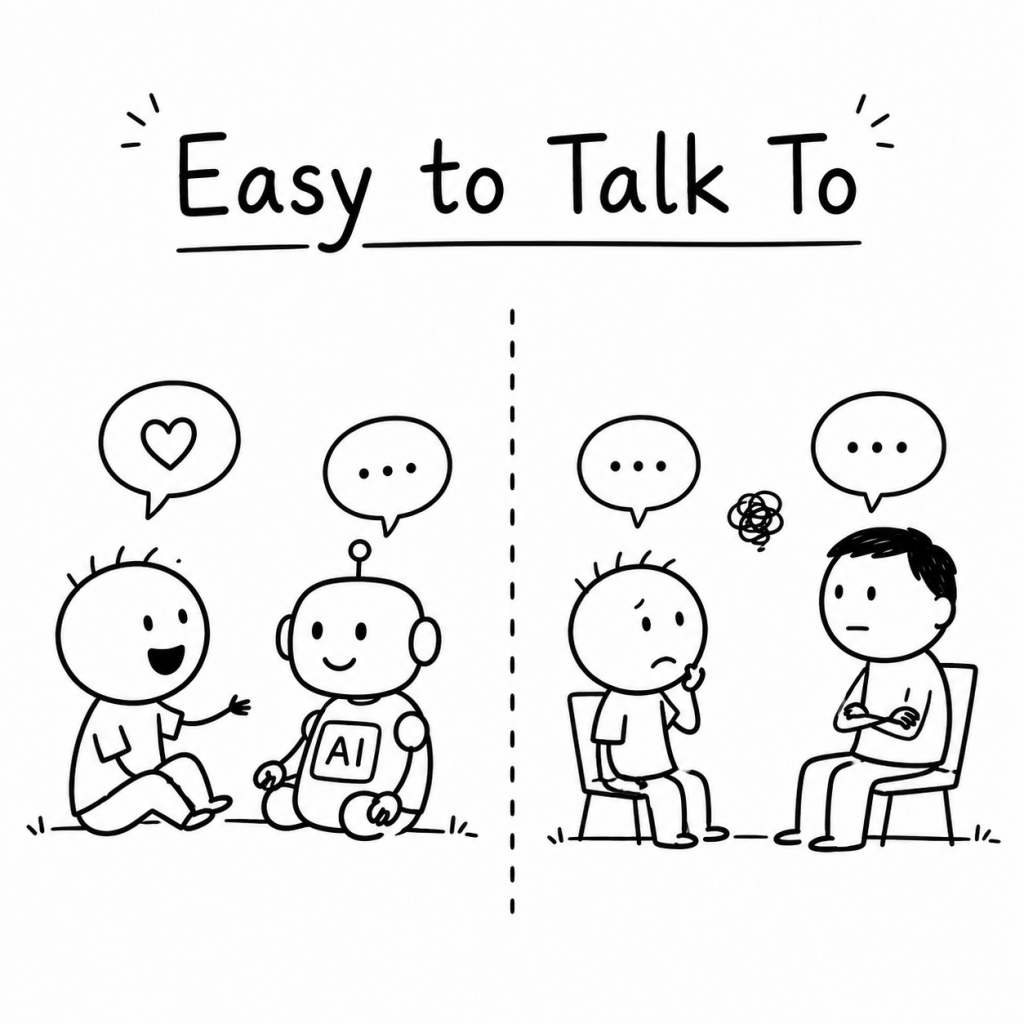
AI can feel easier to talk to than a person.
It does not look impatient. It does not interrupt to tell its own story. A child can rewrite a question, repeat a concern or pause without seeing another person’s reaction.
That low-friction experience can be useful.
It can also feel more emotionally meaningful than it really is.
Start by understanding the appeal
If a child prefers talking to an AI, beginning with ridicule may close the conversation.
Ask what the interaction provides:
- Time to organise a thought
- Freedom to ask a question repeatedly
- Less fear of embarrassment
- Immediate availability
- Help finding words for a difficult topic
The answer can reveal what feels difficult in human conversations too.

Patient language is not a caring relationship
An AI can generate language that sounds warm and attentive.
That does not mean it experiences concern, knows the child’s full situation or can take responsibility for their wellbeing.
A useful distinction is:
The conversation may feel supportive. The system is still a tool producing responses.
Children do not need a philosophical lecture every time they use AI. They do need a clear mental model so fluent language is not mistaken for human understanding.
Use AI to prepare for a human conversation
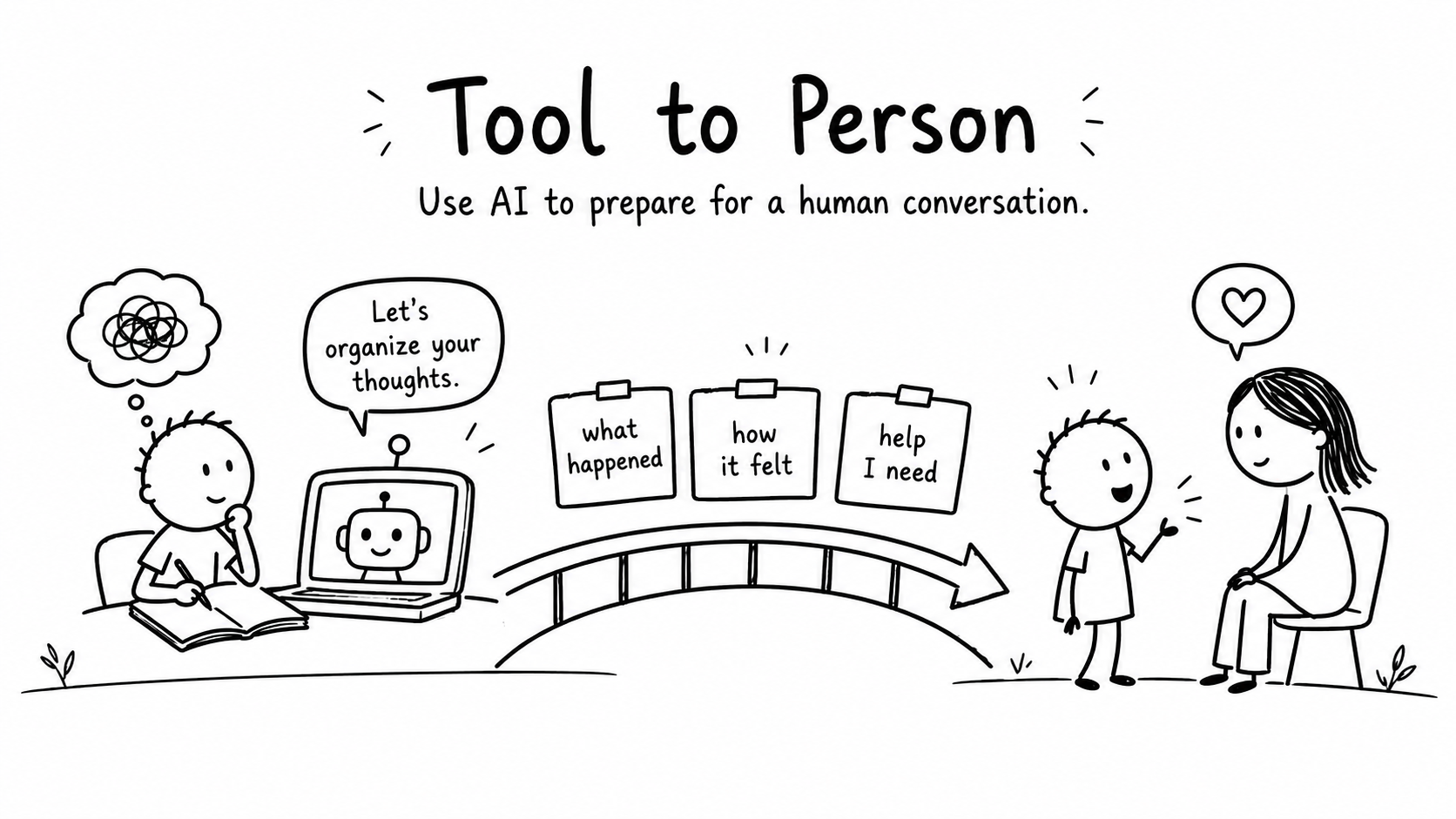
AI can sometimes help a child organise what they want to say.
- List the main points of a concern.
- Practise how to ask a teacher for help.
- Draft questions for a parent or doctor.
- Compare calm ways to describe a disagreement.
- Identify which part feels hardest to say aloud.
The useful direction is from tool to person, not from every difficult relationship toward permanent replacement by a tool.
Protect private information
Emotional conversations often contain identifying details about the child and other people.
Before sharing, remove information that is not necessary:
- Names and contact details
- Exact school or location
- Private photographs
- Another person’s confidential information
- Passwords, account details or financial information
Parents should also review the age requirements and current privacy settings of the specific tool.
Create a clear human-support rule
Families can agree that certain situations always move beyond AI.
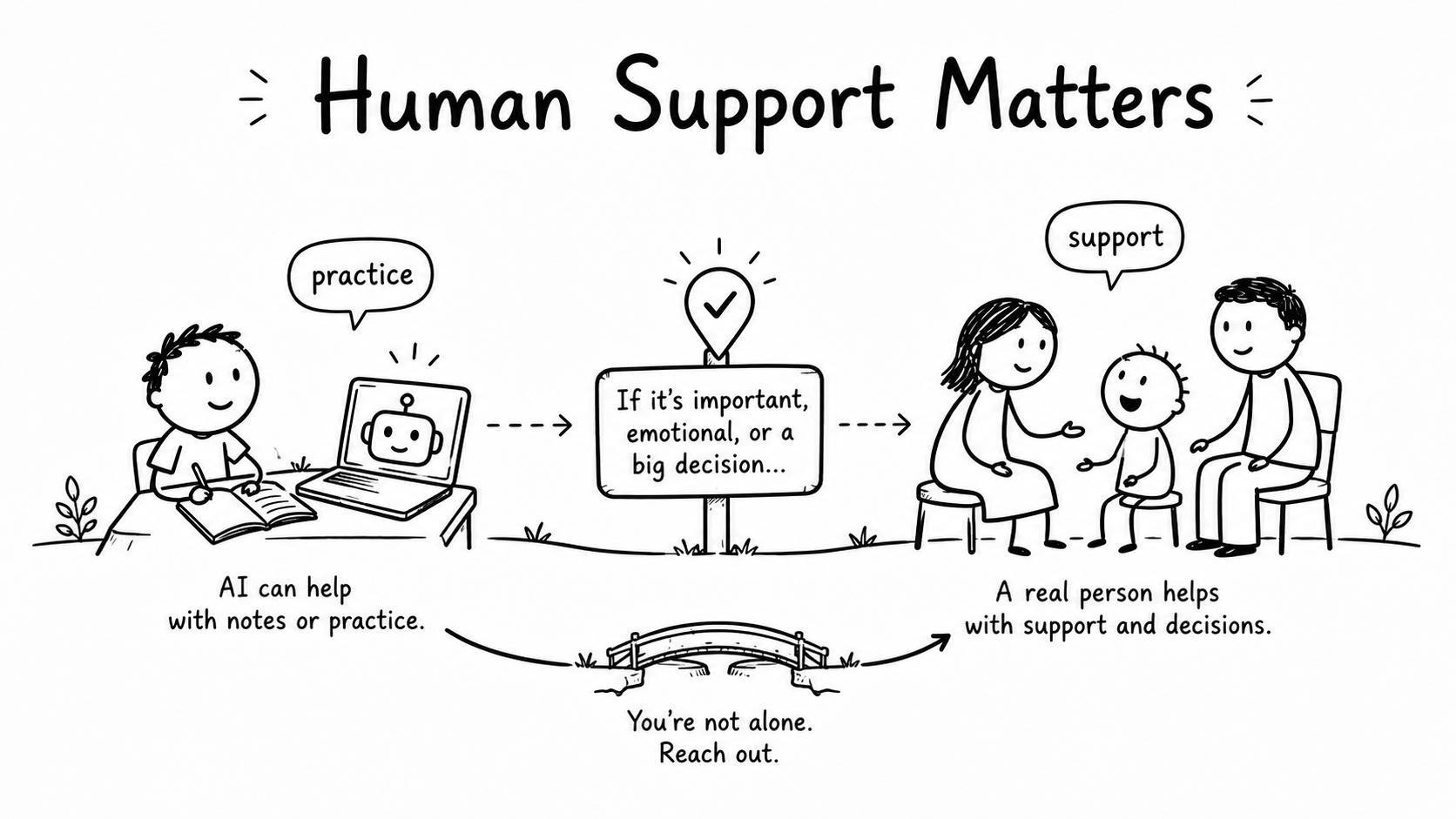
- The child feels unsafe.
- Someone is threatening, exploiting or bullying them.
- The issue involves health, self-harm or immediate danger.
- The child is being asked to keep a harmful secret.
- An important decision requires an adult who knows the real context.
The child should know which trusted people they can contact and how to reach them.
Let the preference teach adults something too
If a child says an AI is easier to talk to, adults can become defensive.
A more useful response is curiosity:
- Do we interrupt too quickly?
- Do we move straight into advice?
- Does the child expect anger or judgment?
- Can we create a regular low-pressure time to talk?
The AI may be exposing a need for more patient human space.
A conversation bridge experiment
Ask the child to use paper or an AI tool to prepare three sentences:
- What happened
- How it affected me
- What help I am asking for
Then let them choose a trusted person and use the notes to begin the conversation.
AI can provide time, language and a private-feeling rehearsal space.
Children still need people who can know the situation, care about the outcome and act when support is required.
 ThinkBySketch
Leave a comment