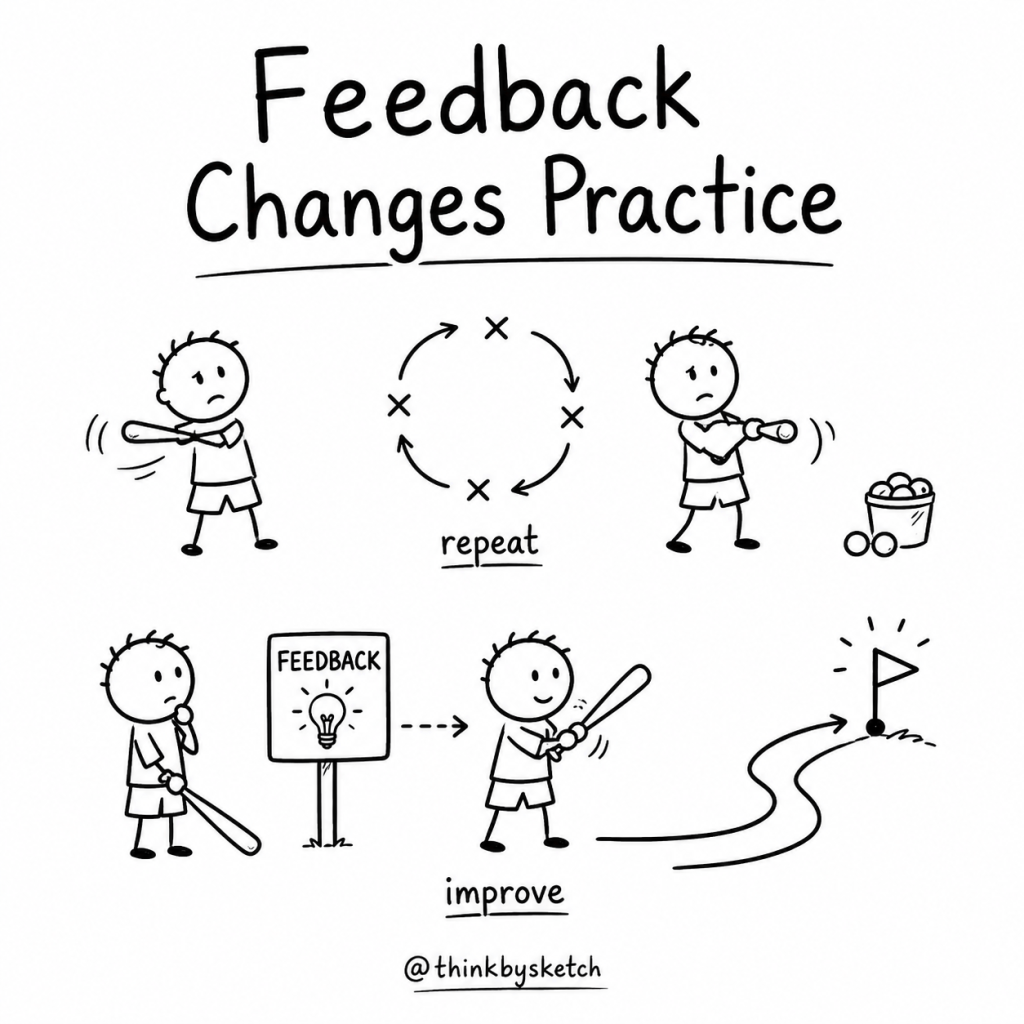
“Just practise more” can be incomplete advice.
A child can repeat the same action many times and become faster at the same mistake.
Practice becomes more useful when each attempt produces feedback that changes the next one.
An attempt needs a question
Before practising, define what the child is trying to improve.
“Write better” is difficult to act on. More useful targets might be:
- Make the opening clearer.
- Use evidence for one claim.
- Keep each paragraph focused on one idea.
- Remove words that do not change the meaning.
A specific question helps the child notice relevant feedback.
Use short attempts
Long tasks delay feedback. By the time the child reaches the end, it may be difficult to remember which decision caused which result.
Break practice into smaller cycles:
- Try one small part.
- Check the result.
- Choose one change.
- Try the part again.
A musician might practise two difficult bars. A child learning multiplication might compare two strategies on three questions. A young designer might test one bridge shape before building the complete model.
Feedback should point to the work
“Good job” communicates approval. It gives little information for the next attempt.
More useful feedback identifies the effect of a decision:
- “This arrow made the sequence easier to follow.”
- “Your second example supports the claim more clearly.”
- “The wider base held more weight.”
- “You slowed down at the difficult transition and made fewer errors.”
The child can now decide what to keep or change.
Teach children to generate their own feedback
Adult feedback is useful, but children also need ways to inspect their own work.
Try prompts such as:
- What worked as intended?
- Where did the result differ from your prediction?
- Which part are you least certain about?
- What is one change worth testing?
- What should remain unchanged?
This moves reflection from “Was it good?” to “What information did this attempt give me?”
Do not change everything at once
If the child changes many features, they may not know which change affected the result.
When possible, change one meaningful variable and compare the versions.
This is useful in experiments, writing, drawing and physical skills. It helps the child connect action with consequence.
Try a three-version practice
Choose a task small enough to repeat three times.
- Make version one quickly.
- Identify one change and make version two.
- Keep or reverse that change, then make version three.
Place the versions side by side. Ask the child to explain which decision produced the most useful difference.
Knowledge gives a child options.
Action creates an attempt.
Feedback turns the attempt into information for what comes next.
 ThinkBySketch
Leave a comment