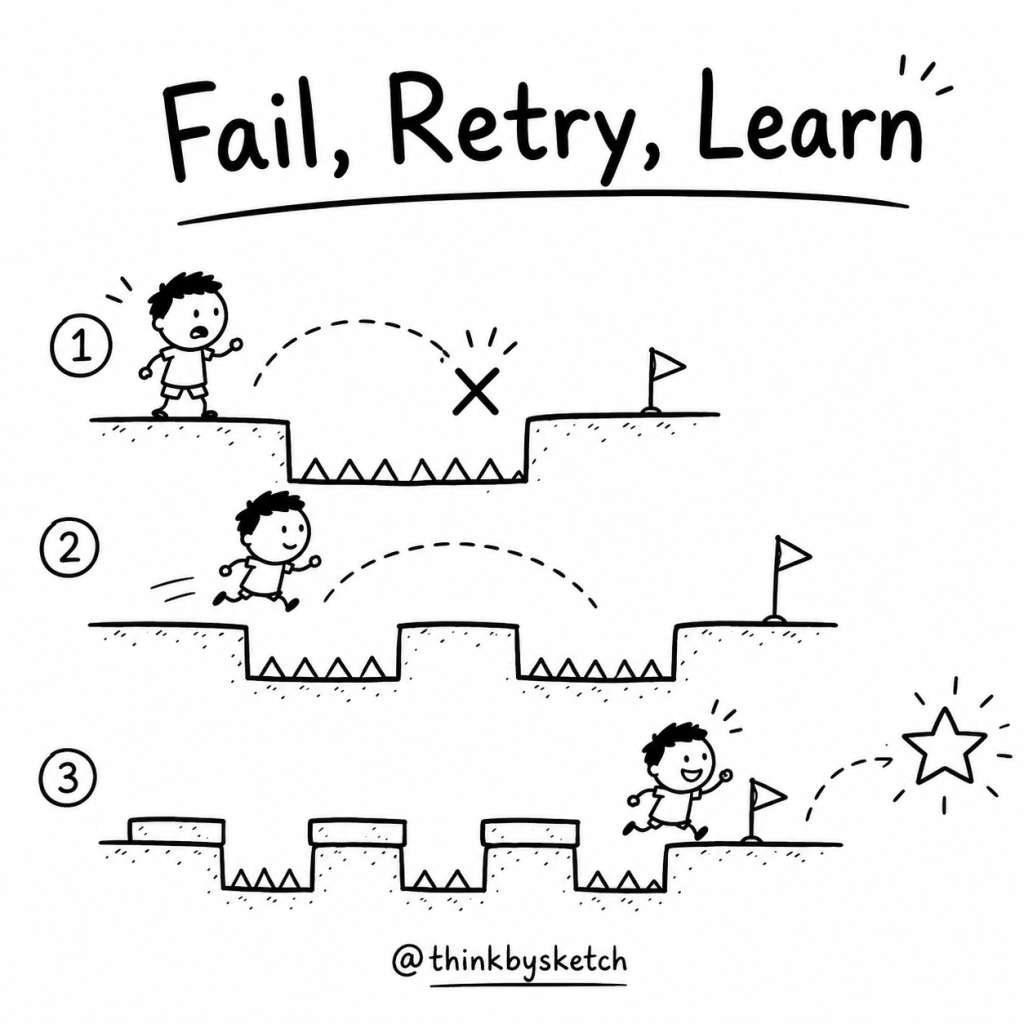
Children often retry a difficult game level without being told to “show resilience.”
They fail, adjust and try again.
The same child may avoid a difficult worksheet after one mistake.
The difference is not simply motivation or character. Games often make the next attempt easier to understand.
Games create a clear feedback loop
In many games, the player knows:
- What the immediate goal is
- What action caused the failure
- How quickly they can try again
- Whether the new strategy worked
The failure is usually specific. The next action is visible. The cost of another attempt is manageable.
Many real learning tasks are less clear. “Do better” gives a child no obvious next move.
Persistence is useful when the strategy changes
Repeating the same action is not always productive persistence.
Useful retrying follows a loop:
- Attempt
- Notice what happened
- Change one thing
- Try again
Children use this naturally in games when they change timing, route, equipment or sequence.
Adults can make the same loop visible in writing, maths, sport or making.
Ask about the strategy, not only the score
After watching a child play, ask:
- “What did you notice after the last attempt?”
- “Why did you change your approach?”
- “What mistake gave you useful information?”
- “How did you decide it was time to ask for help?”
This shifts the conversation from winning to learning decisions.
Do not assume the lesson transfers by itself
A child who persists in a game will not automatically persist everywhere else.
The contexts differ. A game may provide fast feedback, clear rules and a low social cost for failure. A classroom task may feel ambiguous or expose the child to judgment.
Help the child name the connection:
“In the game, you tried a new route after the first one failed. What would a new route look like in this problem?”
The comparison does not guarantee transfer. It gives the child a strategy they can deliberately test.
Use game design to improve a learning task
When a child is stuck, borrow four features from a well-designed game:
- Clear level: Define one small goal.
- Fast feedback: Check one attempt immediately.
- Visible progress: Show what improved.
- Another life: Make retrying normal and inexpensive.
This does not require turning everything into points or rewards. It requires designing the next attempt clearly.
A game-to-life experiment
Ask the child to choose one difficult game moment and draw four boxes:
- What I tried
- What happened
- What I changed
- What happened next
Then use the same four boxes for a non-game challenge.
The useful lesson is not “never give up.”
It is “use each attempt to decide what to change next.”
 ThinkBySketch
Leave a comment