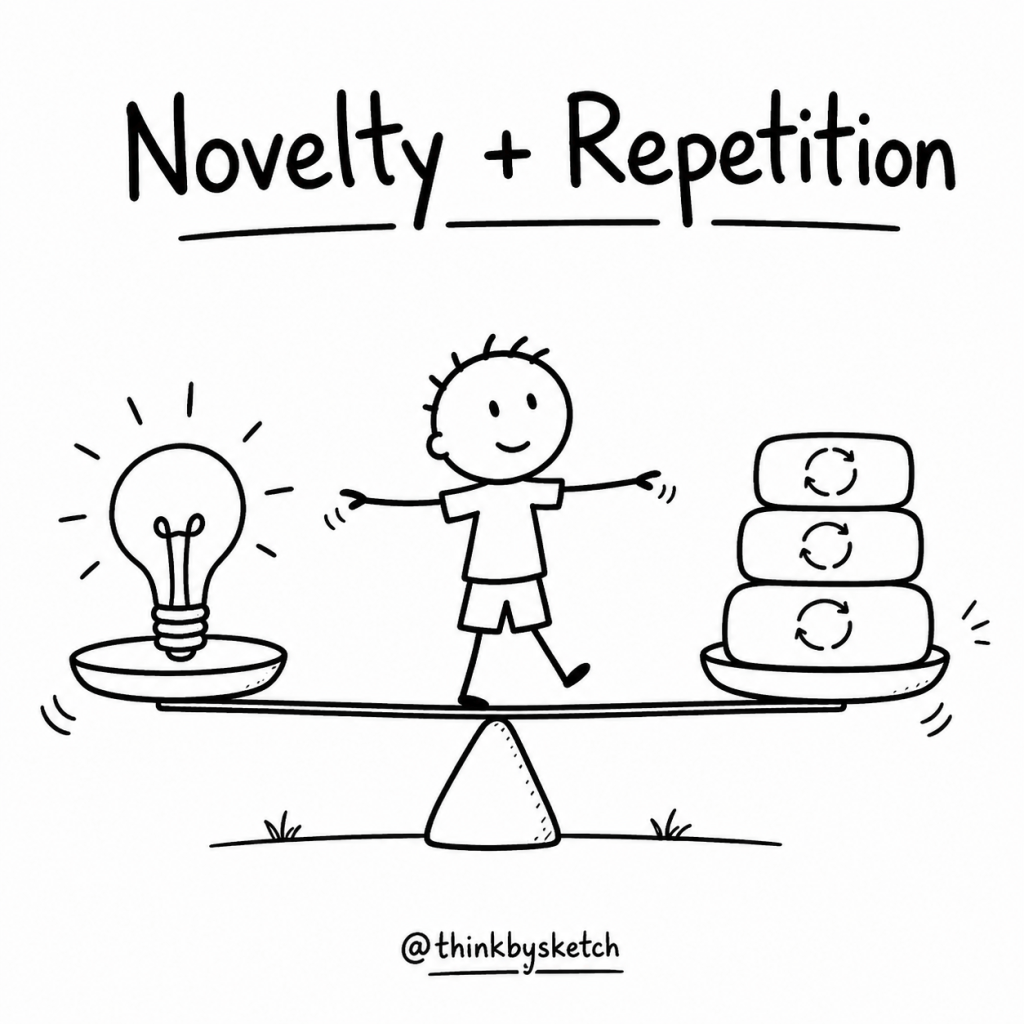
Creativity is often presented as a sudden spark.
A child gets an unusual idea, makes something surprising and appears creative.
But the spark is only one part of the process.
Children also need repeated chances to develop an idea, notice what is weak and try again.
Novelty starts the exploration
A fresh prompt can open possibilities:
- Design a chair for someone who cannot bend their knees.
- Draw a map of an imaginary underground city.
- Invent a game using only paper and a spoon.
- Explain rain without using the word “water.”
The unusual constraint interrupts the first obvious answer. It invites the child to search more widely.
Repetition develops creative judgment
Repeating the same type of activity does not have to mean copying the same result.
A child who draws many characters begins to notice shape, expression and proportion. A child who builds several paper bridges begins to compare structures. A child who writes many openings begins to recognise which ones create interest.
The repetition gives them examples from their own work. Those examples make comparison possible.
Do not confuse consistency with sameness
Consistency means returning to the practice. Sameness means repeating without noticing or changing.
To keep repeated practice alive, vary one dimension:
- Change the material.
- Change the audience.
- Add a constraint.
- Reduce the available time.
- Combine two unrelated ideas.
- Improve an earlier version instead of starting over.
The child keeps practising the underlying skill while encountering a new problem.
Make revision part of creativity
Children may assume that a creative person produces a strong first version. When the first attempt disappoints them, they may conclude that they are “not creative.”
Show a different process:
- Make a quick first version.
- Choose one part that works.
- Identify one part that is unclear or weak.
- Change only that part.
- Compare the versions.
This turns revision from punishment into a creative decision.
Praise choices, not a creative identity
Instead of saying only, “You are so creative,” point to the action:
- “You tried three shapes before choosing this one.”
- “You used the failed tower to change the base.”
- “That connection between the moon and an umbrella was unexpected.”
- “You kept the main idea but found a clearer way to show it.”
This helps the child see creativity as something they do, not a label they must constantly prove.
Try a five-version challenge
Choose one small task, such as drawing a tree, designing a bookmark or creating a paper animal.
Ask the child to make five versions. Each version must change one meaningful feature.
At the end, do not ask which one is best immediately. Ask:
- Which version taught you something?
- Which change created a new problem?
- Which two versions would you combine?
- What would version six explore?
Creativity needs room for surprise.
It also needs enough repetition for a child to recognise what is worth keeping, changing and trying next.
 ThinkBySketch
Leave a comment