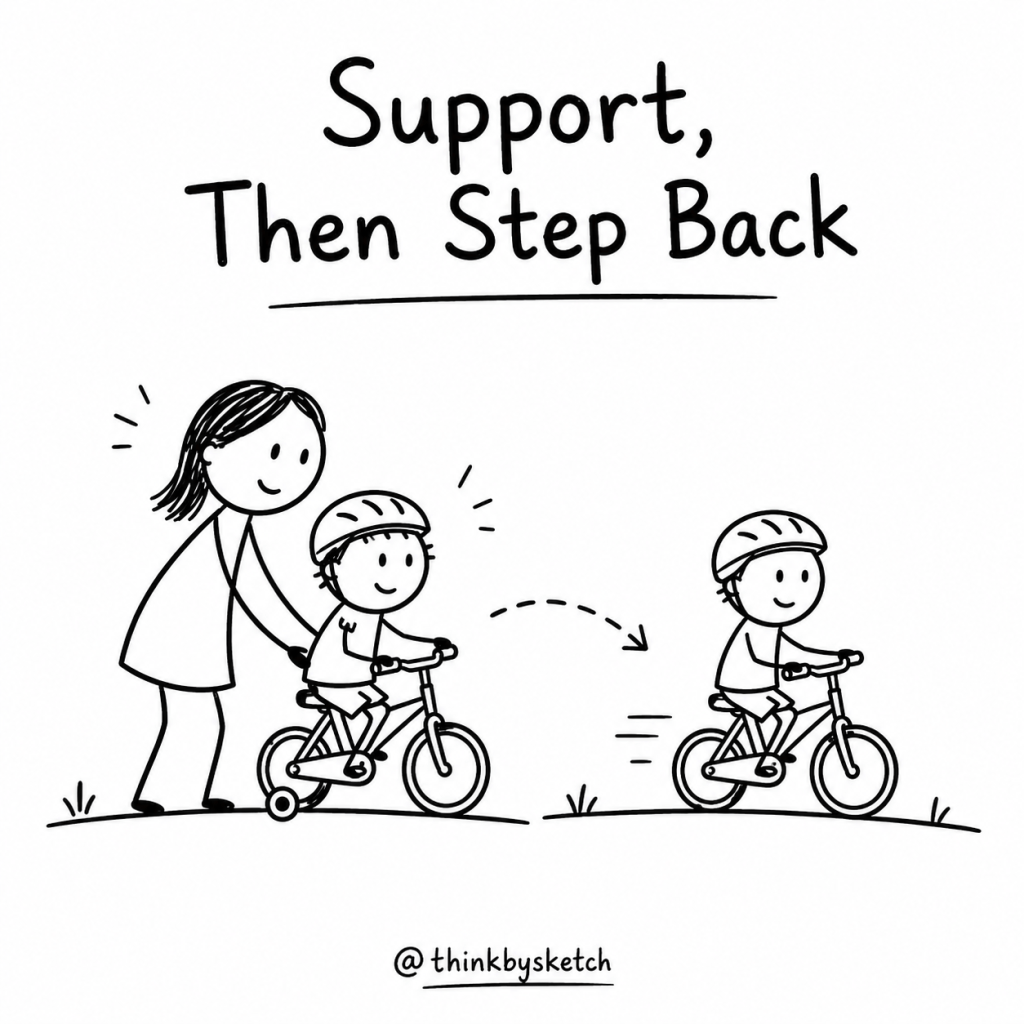
Support is useful when it helps a child attempt the skill.
It becomes less useful when it performs the skill for them.
A bicycle makes this difference easy to see. A stand can keep the bicycle upright while it is parked. It cannot teach a rider how to balance while moving.
Training wheels, a steadying hand and a safe open space can all help. But at some point, the learner needs access to the wobble.
The difficult part often contains the lesson
When children learn a new skill, adults naturally want to reduce frustration. The risk is removing the exact experience that provides feedback.
- A child learns balance by feeling the bicycle lean.
- A child learns to write by deciding what to say.
- A child learns to solve a problem by choosing and testing an approach.
- A child learns to explain by organising the idea in their own words.
If the adult controls each of these steps, the result may look successful while the underlying skill receives little practice.
Use support that can fade
Good learning support has an exit plan.
For example:
- Show one complete example.
- Complete the next example together.
- Let the child try while you give prompts.
- Remove the prompts and observe.
- Return only the support that is still needed.
This keeps support responsive. It does not disappear on a fixed schedule, and it does not remain simply because it has become comfortable.
Make the risk small enough to attempt
Children do not need dramatic failure to learn. They need manageable feedback.
For a bicycle, that may mean a helmet, a quiet space and an adult nearby. For a presentation, it may mean practising for one family member before speaking to a class. For a maths problem, it may mean trying one question before completing the page.
The goal is not to make fear disappear. It is to make the next attempt possible.
Notice when help becomes control
Ask three questions:
- Who is making the important decision?
- Who receives the feedback from the attempt?
- Could I reduce my help by one level?
If the adult is deciding, doing and correcting everything, the child may be watching rather than practising.
A support-fading experiment
Choose one skill your child is learning.
Draw four boxes labelled:
- I show
- We try
- You try with a hint
- You try alone
Move between the boxes based on what the child demonstrates. Do not treat the final box as a permanent destination. A harder version of the skill may require support again.
The best support does not prove that the child never needs help.
It helps them do a little more of the thinking and action themselves.
 ThinkBySketch
Leave a comment