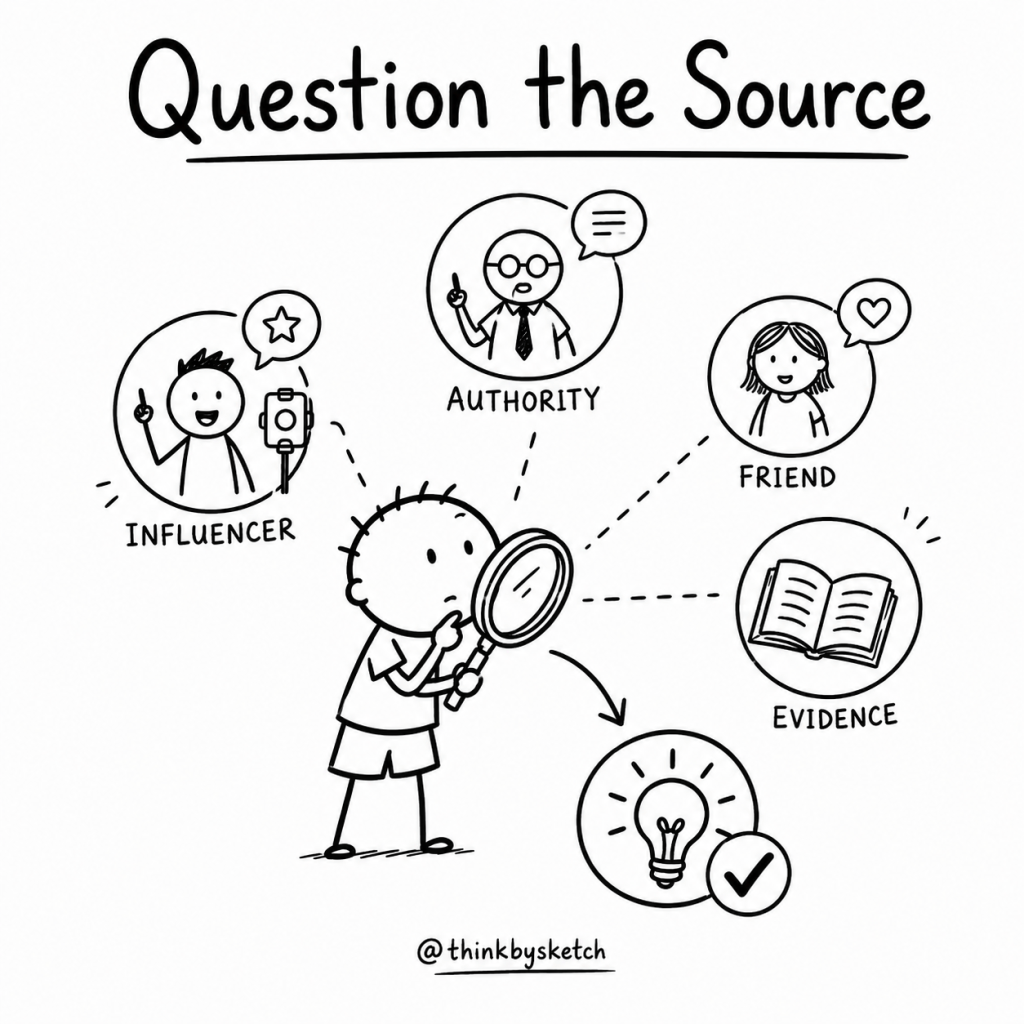
Good advice can still come from an imperfect person.
Bad advice can arrive from someone who looks successful.
That is why “Who said it?” is not enough.
I once wrote a sarcastic post about following one person for relationship advice, productivity, nutrition and money. The joke was that I kept changing my life around a stranger’s recommendations without examining whether the advice fitted my situation.
The deeper problem is now common in family life. Children meet confident advice everywhere. It appears in short videos, gaming streams, product reviews, study tips, AI answers and posts shared by friends.
We cannot check every claim for them. We can teach them how to pause.
Confidence is not the same as reliability
A polished video can make an opinion feel like a fact. A large audience can make popularity look like proof. A personal story can feel universal even when it describes only one person’s experience.
Children need language for these differences:
- Experience: “This worked for me.”
- Opinion: “I think this is better.”
- Evidence: “Here is information that can be checked.”
- Promotion: “I benefit if you believe or buy this.”
One post may contain more than one of these. The aim is not to distrust everything. It is to identify what kind of claim is being made.
Use the SIFT questions
When a child brings an interesting claim, try four questions:
- Source: Who is saying this and what do they know?
- Incentive: What might they gain from my attention, agreement or purchase?
- Fit: Does this advice match our age, situation and values?
- Test: What could we check before acting?
These questions work for influencers, news, advertisements and AI-generated answers.
Do not replace one authority with another
A common response is to tell a child which creators are trustworthy. That may help temporarily, but it leaves the child dependent on our list.
A stronger approach is to compare claims together.
For example, suppose a video says a particular study method guarantees better marks.
- Find another source that explains the method.
- Look for limits or situations where it may not work.
- Try it on one small task.
- Discuss what changed and what did not.
The child learns that advice is a hypothesis to examine, not a command to obey.
Keep the conversation curious
Ridiculing a creator can make a child defend them more strongly. Start with interest instead:
“What part of this felt convincing to you?”
Then explore the claim, the presentation and the missing information.
This protects the relationship while practising judgment.
A ten-minute family experiment
Choose one harmless piece of online advice together.
Write four headings on paper: Source, Incentive, Fit and Test.
Fill them in without deciding immediately whether the creator is “good” or “bad.”
End with one question:
“What would we need to know before using this advice?”
The goal is not to raise children who reject every influence.
It is to raise children who can learn from people without handing over their judgment.
 ThinkBySketch
Leave a comment