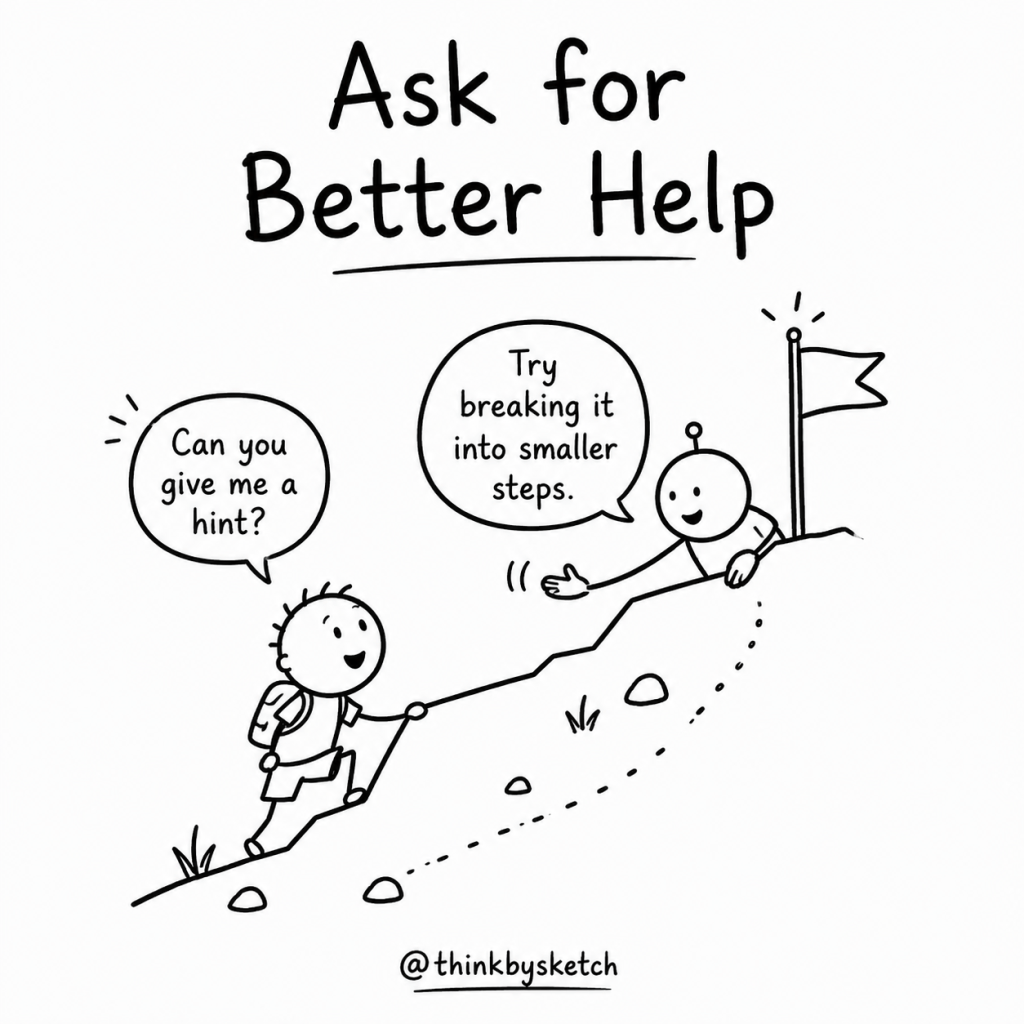
“I need help” is an important sentence.
It is also only the beginning.
A child may ask too early because uncertainty feels uncomfortable. They may wait too long because asking feels embarrassing. Or they may ask for the entire answer when one small hint would be enough.
The useful skill is not simply asking for help. It is learning when, where and how much help to request.
First, identify the stuck point
Before an adult solves the problem, ask the child to show what they already understand.
- “What have you tried?”
- “Which step still makes sense?”
- “Where did it stop making sense?”
- “What kind of help would let you continue?”
This turns a vague request into a clearer diagnosis.
It also prevents the adult from explaining parts the child already understands.
Use a ladder of help
Help does not have to arrive as a complete solution. It can increase one level at a time.
- Wait: Give the child another minute to think.
- Prompt: Ask a question that directs attention.
- Hint: Reveal one useful clue.
- Model: Demonstrate one similar step.
- Work together: Share the difficult part.
- Take over: Use this when the task is unsafe, urgent or currently beyond the child.
Starting lower on the ladder keeps more of the thinking with the child.
Give children useful request sentences
Some children know they are stuck but do not know how to explain it. Practise sentences such as:
- “Please explain this word, not the whole question.”
- “Can you give me one hint?”
- “Can you show me a similar example?”
- “Please check whether my first step is correct.”
- “I have tried two ideas. Can we compare them?”
These requests protect both support and agency.
Adults should model asking too
Children may hear that asking for help is acceptable while watching adults hide confusion.
Make the process visible:
“I know what I want to do, but I do not understand this part. I am going to ask someone who has more experience.”
This shows that asking is not surrender. It is a decision about how to move forward.
Know when persistence has stopped being useful
Struggle can provide information. Repeating the same failed action without a new idea usually provides less.
A simple rule is:
Try, notice, change something, then ask.
The child makes an attempt, observes what happened and tries a different approach. If they still cannot move, they ask for a specific form of help.
A family help experiment
During one homework, puzzle or making session, use only three help levels:
- Question
- Hint
- Show one step
Let the child choose the level they need. Afterward, ask which level was enough and whether they could continue independently.
The aim is not to make children solve everything alone.
It is to help them use other people’s knowledge without handing over their own thinking.
 ThinkBySketch
Leave a comment