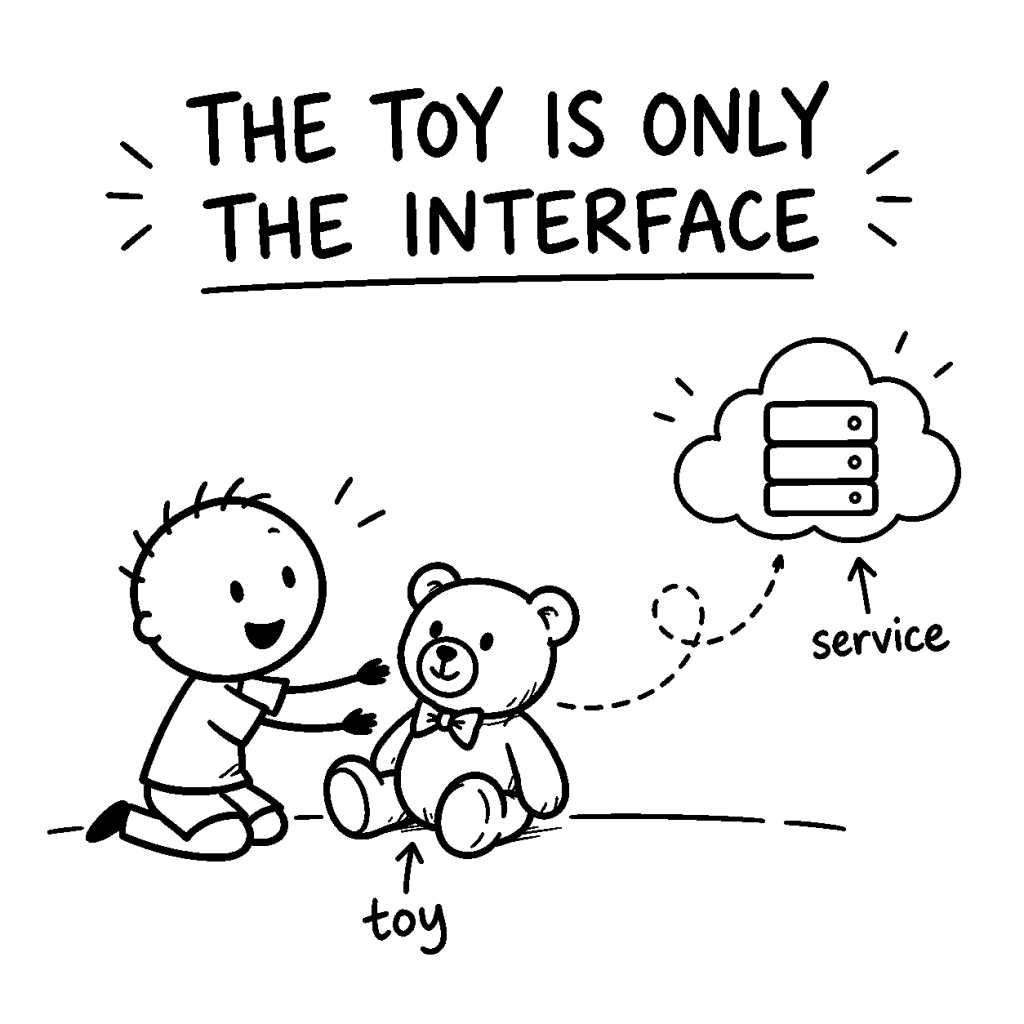
A teddy bear sits on a child’s bed.
A parent sees a toy.
But if that bear contains a microphone, sends speech across the internet and uses an AI model to decide what to say next, something important has changed.
The soft toy is now only the part we can see.
Behind it may be accounts, servers, software updates, stored conversations and an AI service capable of generating new responses.
That gives parents a useful rule:
Do not evaluate an AI toy only as a toy. Evaluate the service hiding inside it.
The teddy bear is only the interface
This became much less theoretical this week.
On September 10, California signed a package of child technology laws that includes SB 867. The law temporarily prohibits the manufacture and sale of toys containing companion chatbots, along with related commercial activity, until January 1, 2031.
You do not need to agree with California’s policy to notice what makes the issue unusual.
We already understand ordinary toy risks.
Could a small part come loose?
Is the material safe?
Is it appropriate for the child’s age?
Conversational AI adds questions that are invisible when we look at the physical object.
Where does the child’s voice go?
Is anything stored?
Can the toy generate something its maker never specifically wrote?
Will it behave differently after a software update?
What happens if the subscription ends?
Those sound less like questions about a teddy bear.
They sound like questions about an online service.
Connected toys change what “playing alone” means
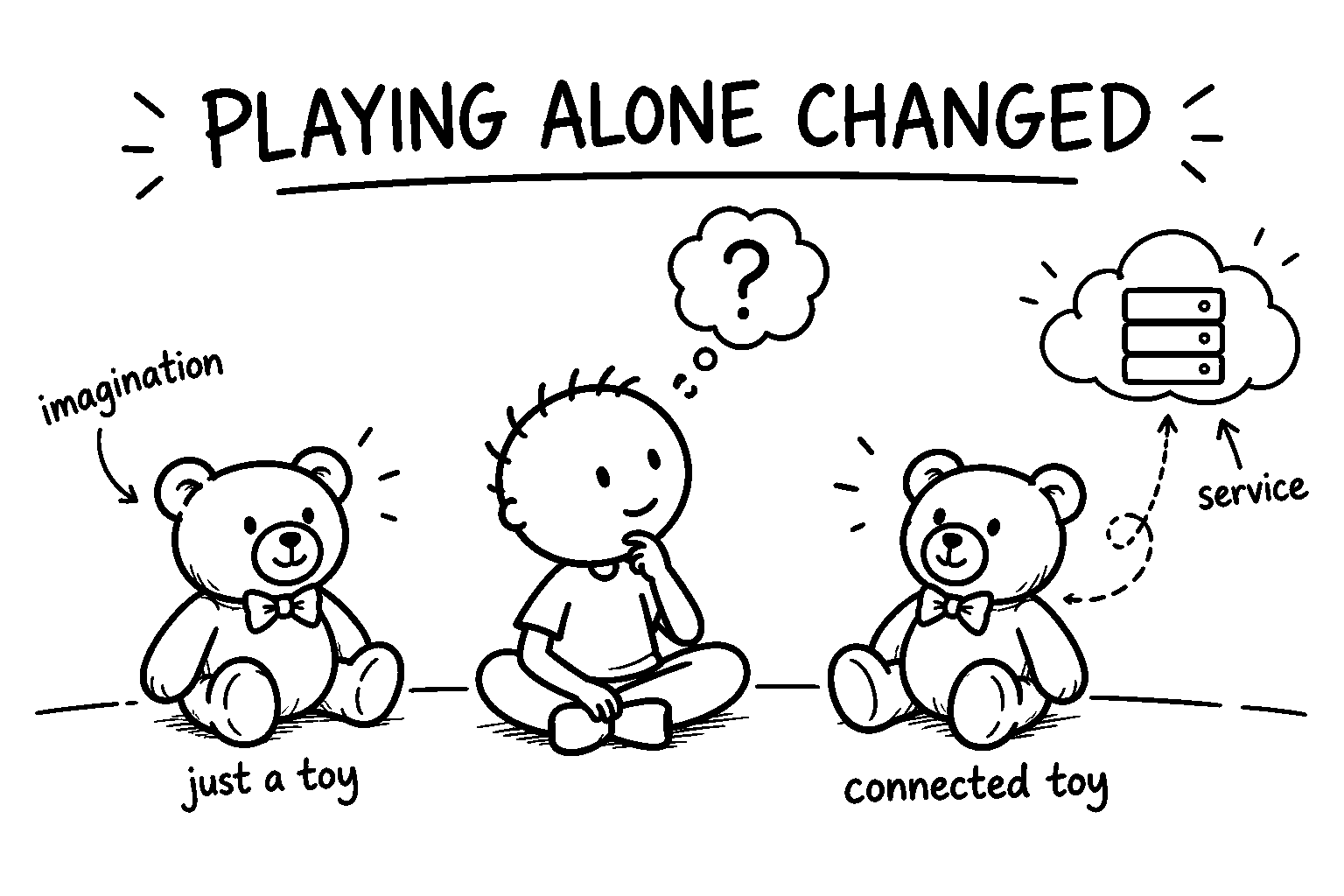
Imagine a child talking privately to two toys in a bedroom.
One is a traditional stuffed animal.
The child invents both sides of the conversation.
The other contains conversational AI.
It hears the child then software somewhere produces a response.
From across the room these can look like the same activity.
Technically they are very different.
A microphone changes the privacy question
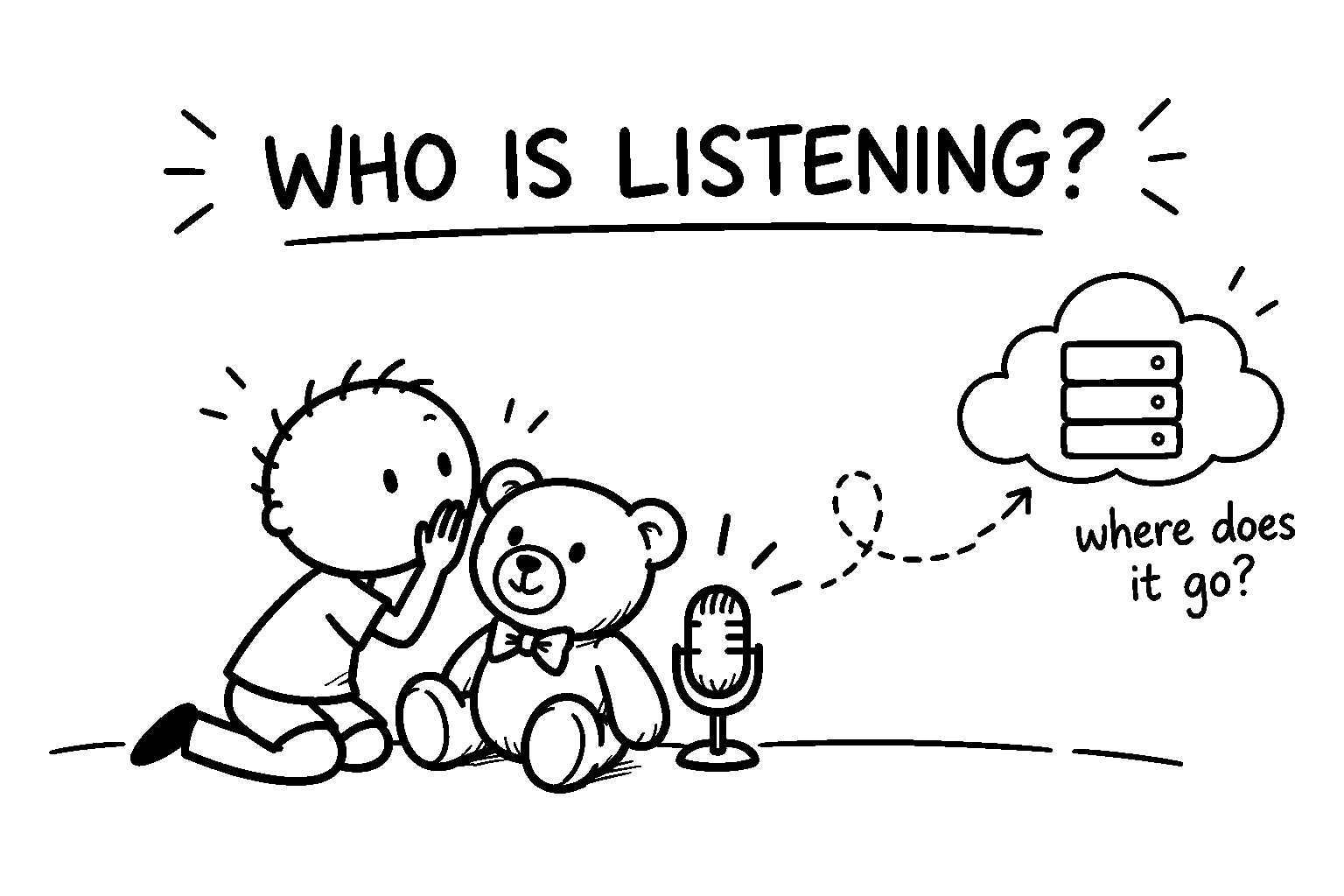
Common Sense Media tested three AI companion toys in early 2026 using accounts configured for children aged 6 to 13. Its assessment raised concerns about voice recordings, transcripts and behavioral information collected by these kinds of products.
That does not mean every microphone-equipped toy records everything or handles data identically.
It means “Does this toy have a microphone?” is only the beginning of the question.
I would also want to know:
- Does speech leave the device?
- What is stored?
- Can I delete it?
- Who else receives it?
- Is the information used to improve the AI?
A child can reveal surprisingly personal information while simply playing.
Their school. Their friends. Something that upset them. Where the family is going tomorrow.
The toy does not need to ask for a home address to hear private information.
Generated conversation changes the content question
There is another difference.
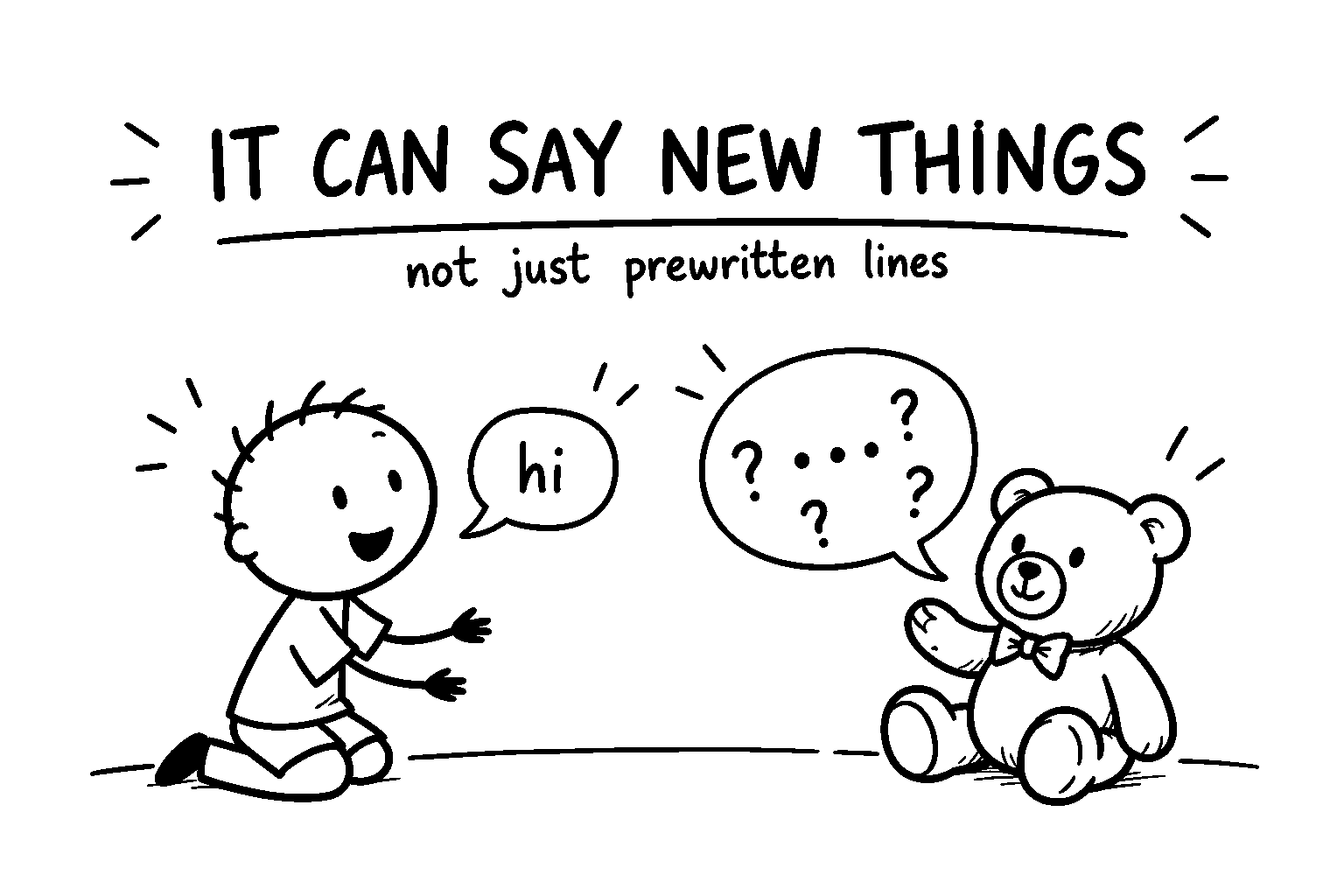
Traditional talking toys usually work from a limited set of prerecorded phrases or predictable actions.
Generative AI can create responses dynamically.
That flexibility is the attraction.
It is also why asking only “What does this toy say?” becomes difficult.
Common Sense Media’s assessment reported that 27% of outputs in its testing were inappropriate for children. The testing covered three products rather than the entire AI-toy market so that number should not be treated as a failure rate for every AI toy.
The broader lesson is simpler.
With generated conversation, parents need to understand the boundaries of the system, not merely a list of built-in phrases.
But connected does not automatically mean bad
There is an easy overreaction here.
Internet connection is not itself evidence that a toy is harmful.
A connected device might offer accessibility features, language practice, interactive stories or experiences that would be difficult to build with prerecorded responses.
AI could eventually make some toys genuinely more useful.
So my test would not be:
Connected = bad.
The more useful distinction is:
Connected = more questions.
The more a toy listens, remembers, generates and depends on remote services, the less I would treat it as a simple purchase.
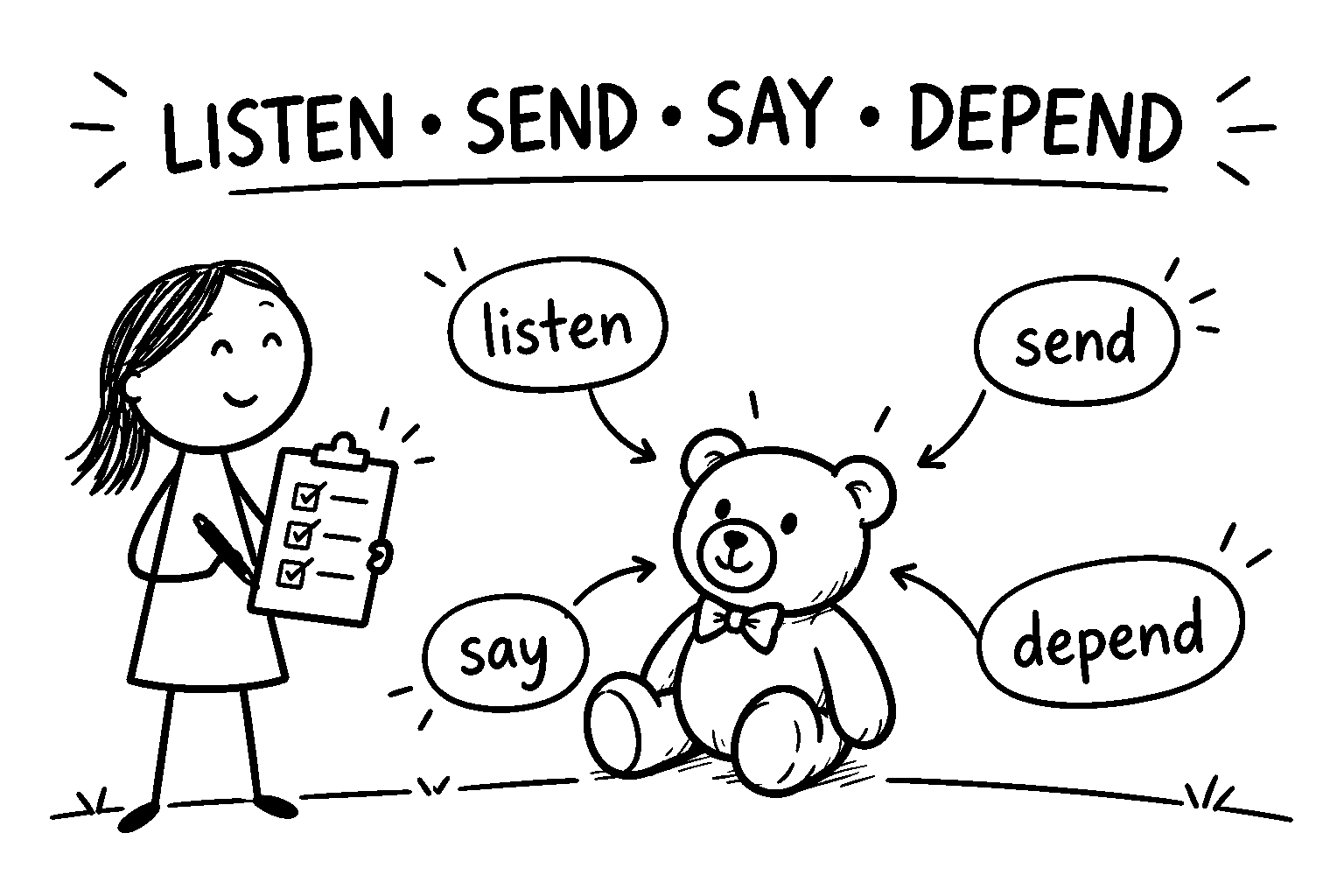
Use the Listen → Send → Say → Depend test
Before buying a conversational AI toy, I would check four things.
Listen: What can the toy hear?
Does it contain a microphone?
Does the child press a button before it listens or can it activate another way?
Can listening be disabled?
Start with what information can enter the system.
Send: Where does the conversation go?
Does processing happen on the toy or on remote servers?
Are recordings or transcripts stored?
For how long?
Can a parent see and delete them?
This turns a vague question like “Is it private?” into something you can actually investigate.
Say: Is the response chosen or generated?
Does the toy select from fixed content?
Does it generate new responses with AI?
What parental controls exist?
How does the company test responses intended for children?
The more open the conversation is, the more important this question becomes.
Depend: What has to keep working after you buy it?
Does the toy need Wi-Fi?
An account? An app? A monthly subscription? Company servers?
What happens if the company changes the service or shuts it down?
An ordinary teddy bear can survive its manufacturer disappearing.
A cloud-dependent teddy bear may not.
That is part of the purchase too.
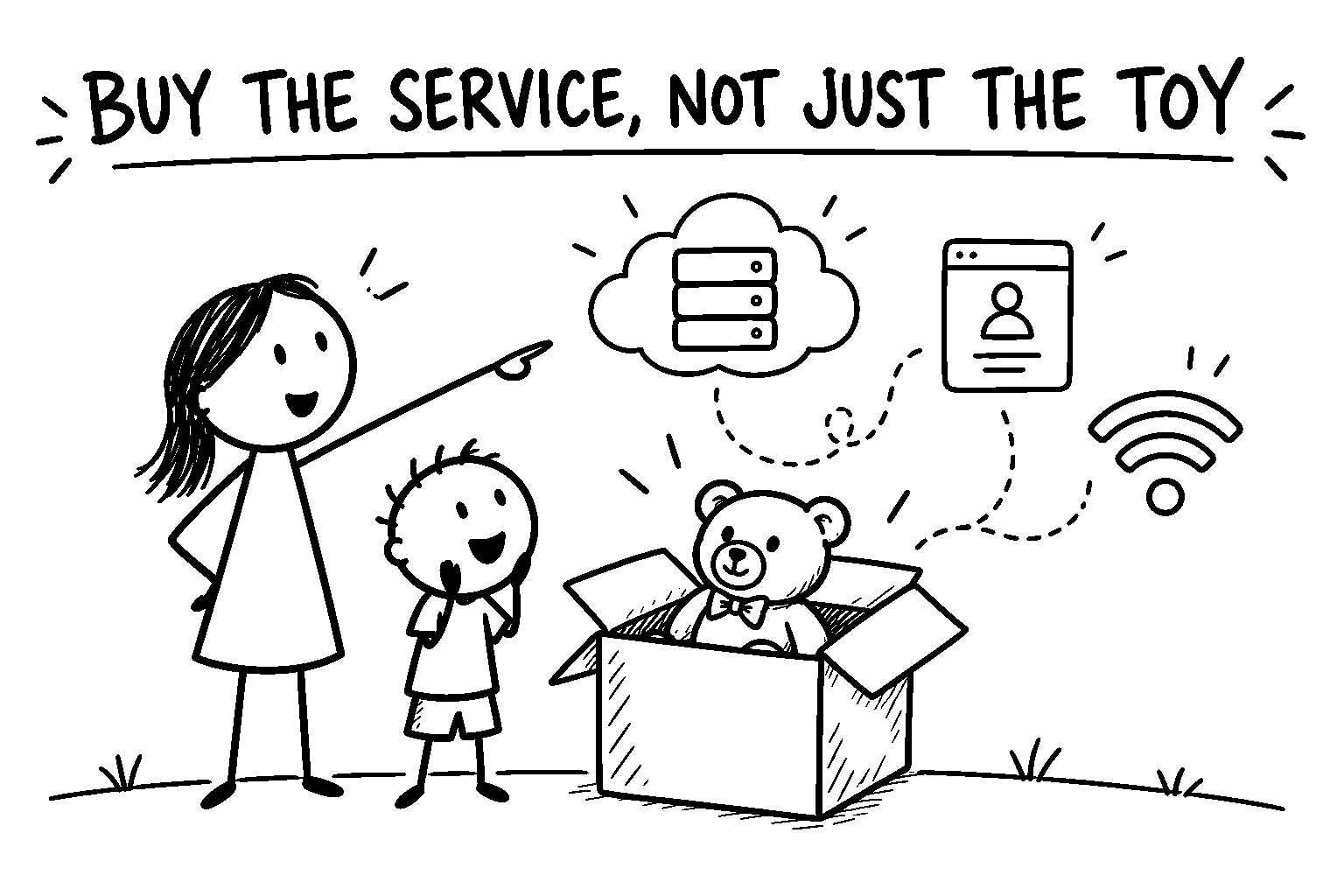
Buy the service, not just the toy
The toy aisle used to make the product boundary fairly obvious.
You bought the thing inside the box.
AI makes that boundary fuzzy.
The thing inside the box may only be the interface to something much larger.
So when a conversational robot, doll or teddy bear looks clever in a demonstration, I would not begin with:
“Will my child enjoy this?”
I would first ask:
- What does it listen to?
- Where does that information go?
- What is it allowed to say?
- What does it depend on after I bring it home?
Listen → Send → Say → Depend.
If I cannot get clear answers to those questions, I do not yet understand the product I am buying.
And that is the important shift.
When AI enters the toy box, parents are no longer buying only an object.
They may also be inviting a service into the room.
 ThinkBySketch
Leave a comment