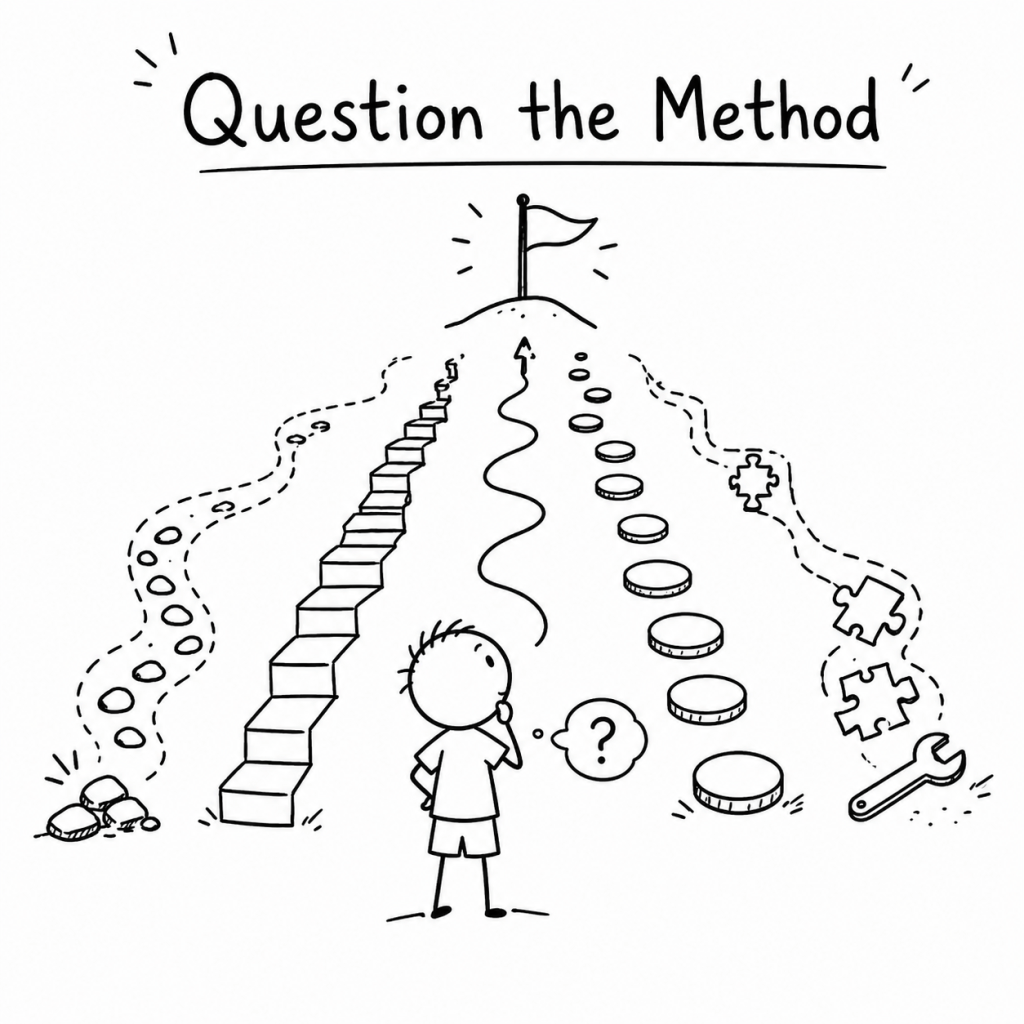
Children are often asked to improve an existing solution.
Make the tower taller. Make the essay clearer. Make the routine faster.
Sometimes the more useful question is different:
“Why are we solving it this way at all?”
First-principles thinking means breaking a problem into facts that can be checked, then building a solution from those facts instead of copying the familiar method.
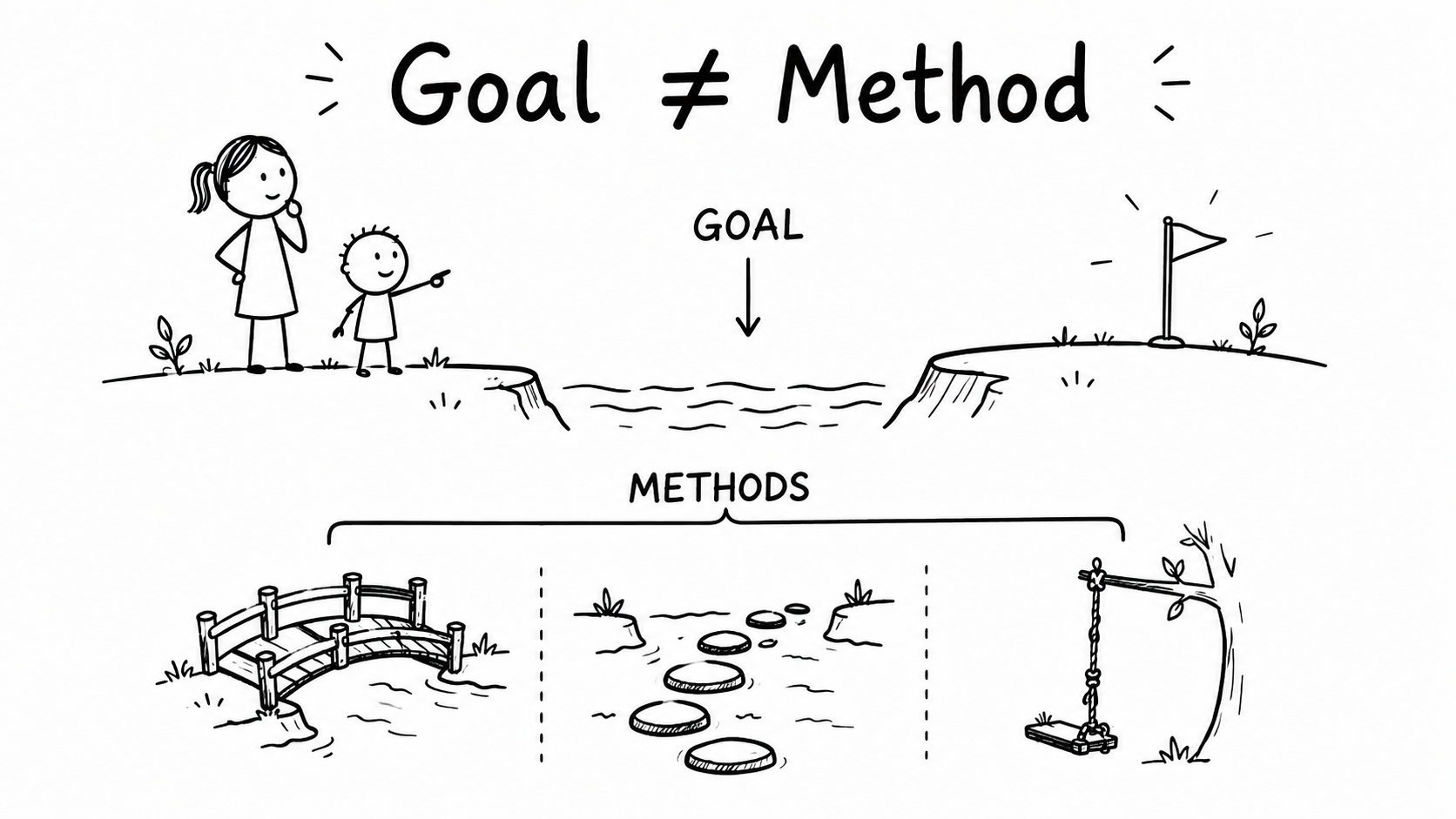
Start by separating the goal from the method
A method can become so familiar that it looks like part of the goal.
For example:
- The goal is to remember important ideas. The method does not have to be copying notes.
- The goal is to cross a gap. The method does not have to be a flat bridge.
- The goal is to explain a concept. The method does not have to be a written paragraph.
- The goal is to practise spelling. The method does not have to be repeating the word ten times.
Ask the child, “What result do we actually need?”
List facts and assumptions separately
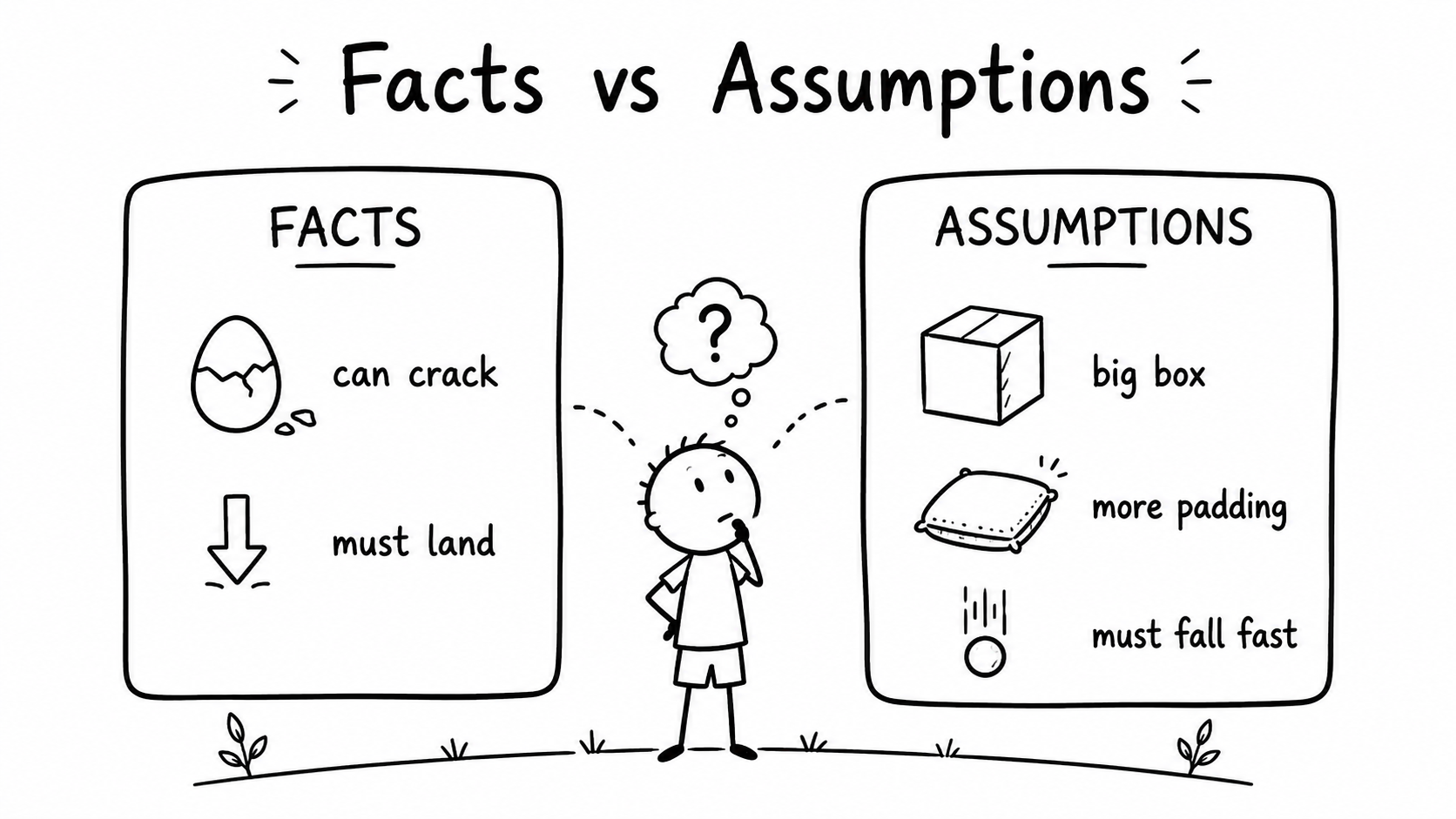
Draw two columns.
In the first, write facts that can be observed or checked. In the second, write beliefs about how the problem is usually solved.
Suppose the challenge is to protect an egg dropped from a height.
- Fact: A hard impact may crack the shell.
- Fact: The egg must reach the ground.
- Assumption: The egg needs a large box.
- Assumption: More padding is always better.
- Assumption: The container must fall quickly.
Once assumptions are visible, they can be questioned rather than followed automatically.
Identify the real constraints
Constraints are conditions the solution must respect.
Some are real:
- Only certain materials are available.
- The object must fit within a size limit.
- The task must be safe.
- The result must be completed within a set time.
Others may be inherited habits:
- It has always been done this way.
- Everyone else uses this shape.
- The first answer in the book must be the only method.
Ask, “What would happen if we removed this rule?”
Rebuild from what must be true
After identifying the facts and constraints, ask the child to create several solutions without looking at the familiar example.
Do not search for the best idea immediately. Search for genuinely different approaches.
- Can the impact be softened?
- Can the fall be slowed?
- Can the force be redirected?
- Can the fragile object move inside the container?
These questions come from the mechanics of the problem, not the appearance of an existing solution.
Test the new idea against reality
First-principles thinking does not mean the new idea is automatically better.
Build a small test. Observe what happened. Compare the result with the goal and constraints.
Then ask:
- Which assumption turned out to be useful?
- Which assumption limited us?
- What fact did we overlook?
- What should change in the next version?
A four-box family experiment
Choose an everyday problem, such as organising school materials, remembering chores or building a toy storage system.
Divide a page into four boxes:
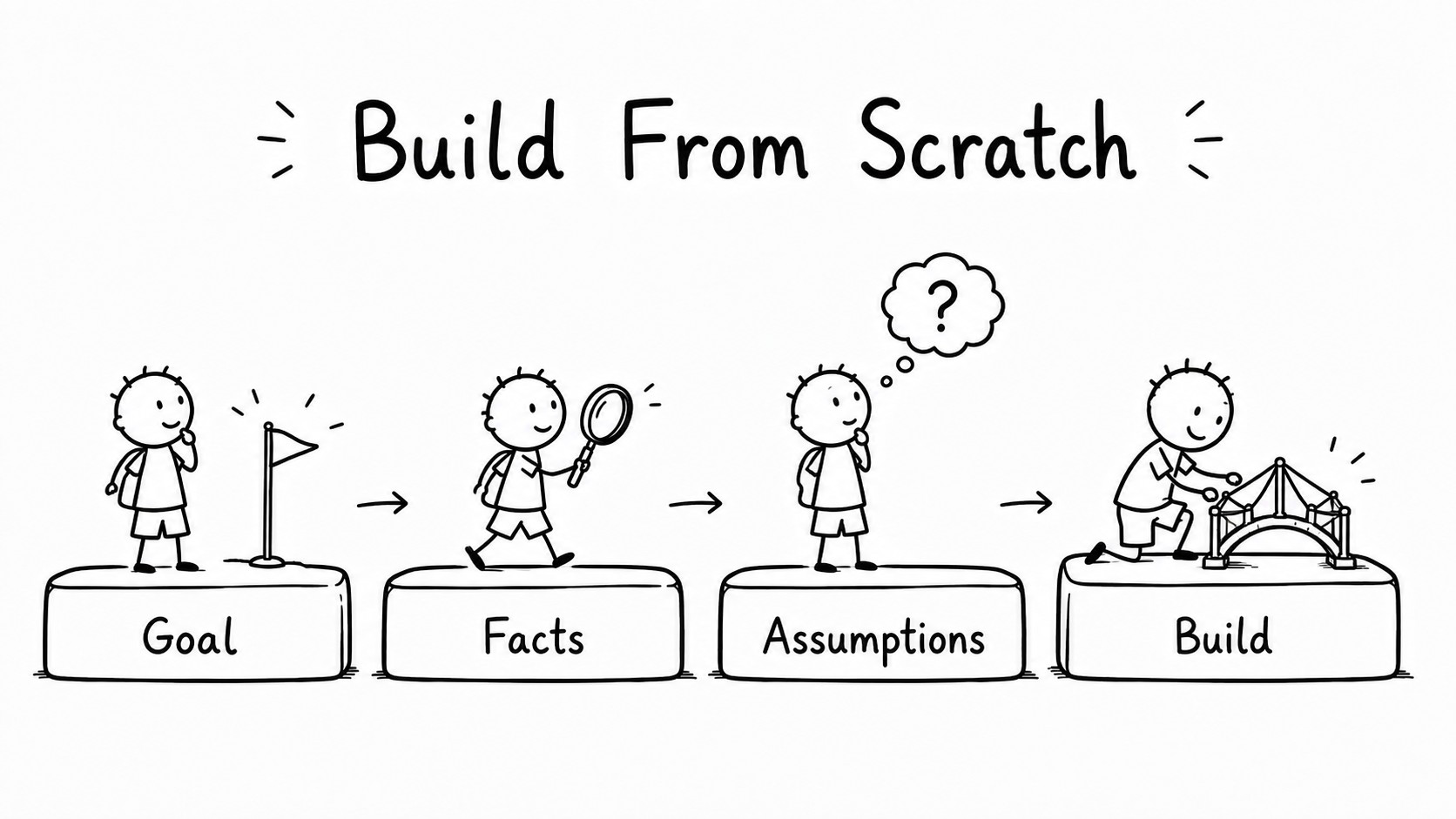
- What result do we need?
- What facts do we know?
- Which rules are assumptions?
- What could we build from scratch?
Test one idea and add a fifth box for what the test taught.
Children should learn how to improve an existing method.
They should also learn that a familiar method is not a law of nature.
 ThinkBySketch
Leave a comment