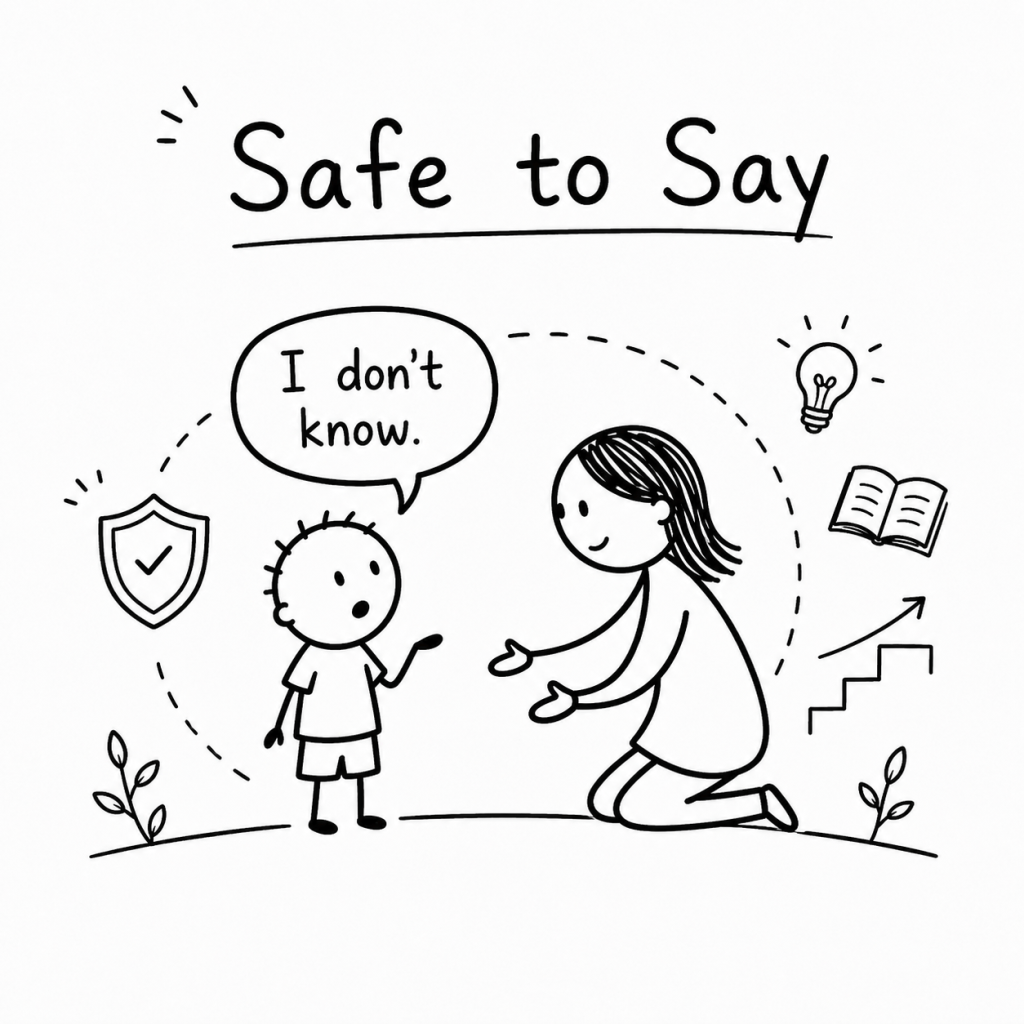
A child who says “I understand” may be reporting confidence.
They may also be trying to end an uncomfortable moment.
When looking knowledgeable feels safer than revealing confusion, adults lose access to the exact place where teaching should begin.
The goal is not to celebrate not knowing as an endpoint. It is to make it a usable starting point.
Replace “Do you understand?”
This question is easy to answer with a quick yes.
Try prompts that reveal more:
- “Which part feels clear?”
- “Where would you need to slow down?”
- “What question might another child ask?”
- “Can you show me the first step?”
- “What are you least certain about?”
These questions make partial understanding acceptable and visible.
Give uncertainty more precise language
“I do not know” can describe several different states.
- “I do not know this word.”
- “I understand the example but not the rule.”
- “I know two possible answers and cannot choose.”
- “I have an answer but cannot explain why.”
- “I do not know how to start.”
The more precisely the child can describe the gap, the more precisely someone can help.
Model changing your mind
Children hear adults ask them to be curious. They also watch how adults respond when they are wrong.
Make your own update visible:
“I thought this worked one way. I found new information and changed my explanation.”
This shows that knowledge can be revised without turning the mistake into humiliation.
Separate honesty from effort
Making “I do not know” safe does not mean allowing it to end every task.
Follow it with a next move:
- What can you observe?
- What do you already know that may connect?
- What could you try?
- Who or what could help?
- How will you check the answer?
Honesty exposes the gap. Effort begins the investigation.
Avoid rewarding only fast answers
When speed receives most of the attention, some children learn that visible hesitation is risky.
Notice other useful contributions:
- A question that exposes an assumption
- A correction supported by evidence
- A clear explanation of a confusing step
- A comparison between two possible answers
- An honest identification of missing information
This broadens the picture of what good thinking looks like.
Try an uncertainty board
During a family project or learning session, divide a page into three columns:
- We know
- We think
- We need to find out
Move ideas between the columns as you test them.
The visual makes uncertainty part of the work rather than a private failure inside one child.
Children do not become stronger learners by pretending every gap is already filled.
They become stronger when they can name a gap, stay curious and take the next responsible step toward understanding it.
 ThinkBySketch
Leave a comment