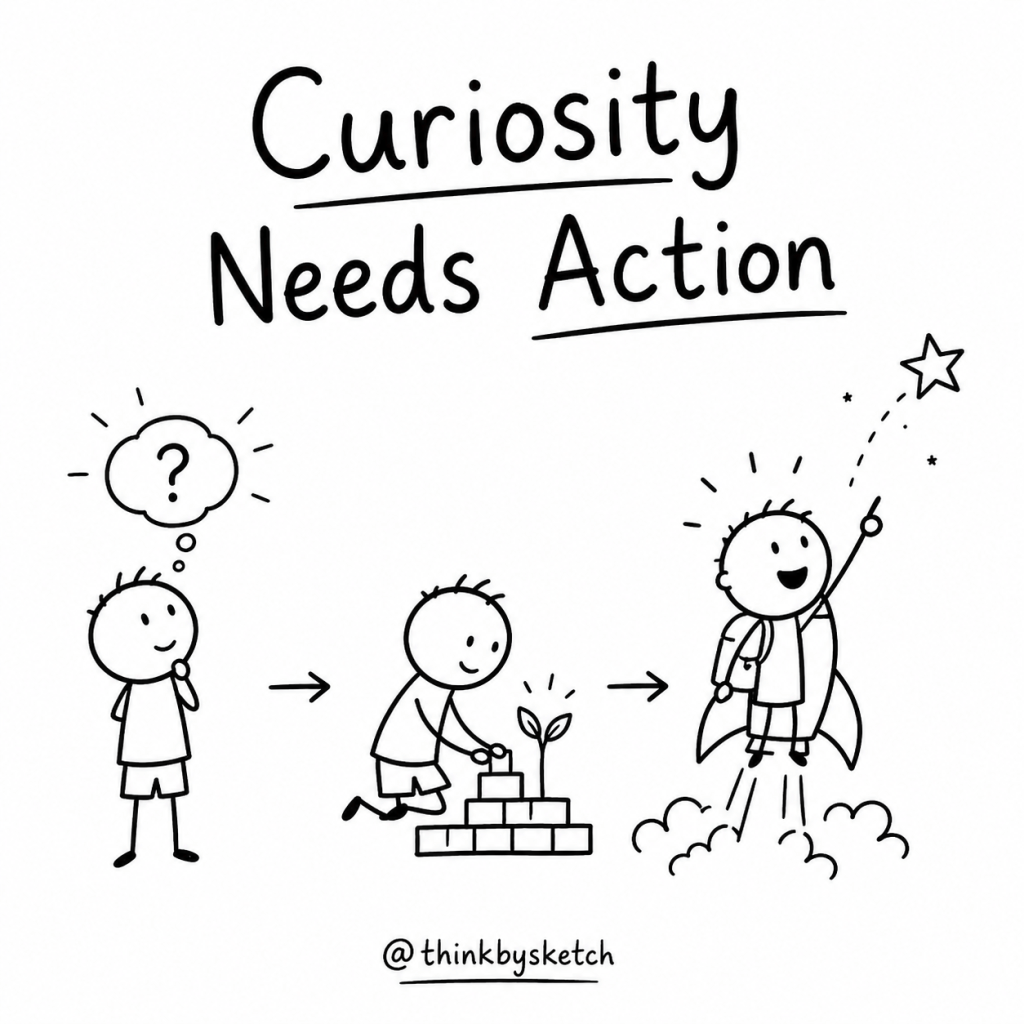
“Follow your passion” sounds encouraging.
It is not always useful guidance for a child who does not yet know what they care about.
Passion often appears after repeated contact with an idea, not before it. Curiosity provides a smaller and more practical starting point.
A child does not need a lifelong interest. They need one question worth exploring today.
Start with a question that can change
Broad questions can feel exciting but difficult to act on.
“How do birds fly?” can become:
- Which paper-wing shape stays in the air longest?
- Why do some seeds spin while falling?
- How does wing size affect a paper glider?
A useful project question is small enough to test and open enough to produce another question.
Add a constraint
Unlimited choice can make starting harder. A constraint gives the child something to push against.
- Build it using only recycled paper.
- Explain it without using a screen.
- Make a version that fits inside a matchbox.
- Use only three shapes.
- Finish a first test in fifteen minutes.
Constraints do not automatically create creativity. They narrow the search enough for decisions to begin.
Make something before researching everything
Research can support curiosity. It can also delay the first attempt.
Ask the child to make a rough model, prediction or sketch before looking for a polished answer.
The first version reveals what they already think. It also creates more precise questions for the research that follows.
Use the question, make, notice, change loop
- Question: What are you trying to find out?
- Make: What is the quickest version you can test?
- Notice: What happened that you expected or did not expect?
- Change: What will you alter in the next version?
The loop can last ten minutes or several weeks. Its value comes from connecting curiosity to feedback.
Do not require every interest to become productive
Not every curiosity needs a competition, portfolio or future career attached to it.
A child may explore an idea briefly and move on. That can still be useful. They practised asking, observing, making and deciding.
The project does not have to become important for the process to matter.
A weekend curiosity card
Give the child a small card with five prompts:
- I wonder…
- My first guess is…
- I can test it by…
- I noticed…
- Now I wonder…
Let the child draw or write. Keep the final question unanswered if they want to continue later.
Passion is not a prerequisite for creative work.
Sometimes it is the result of returning to a question long enough for the child to discover that they care about the answer.
 ThinkBySketch
Leave a comment