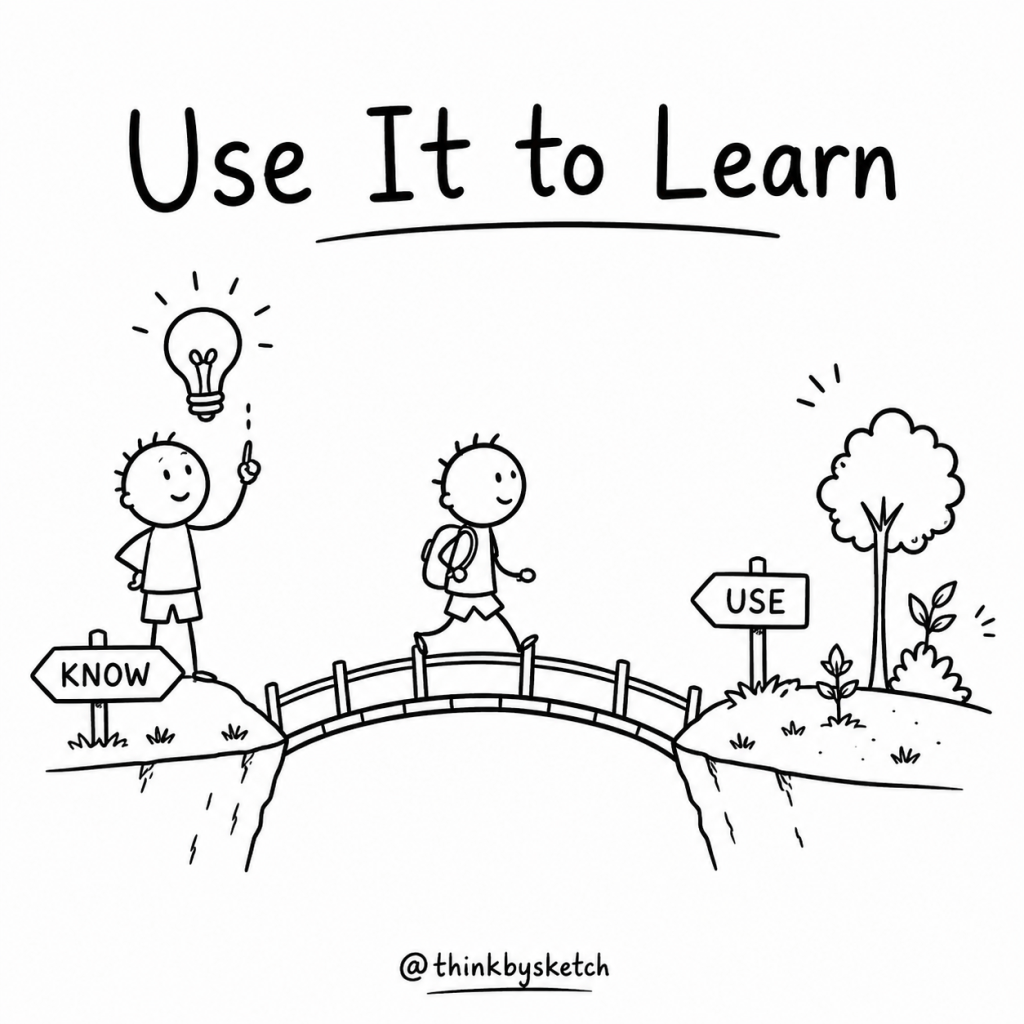
A child can recognise an answer and still be unable to use the idea.
They may follow the worked example, repeat the definition and complete a familiar worksheet.
Then the question changes slightly and the knowledge seems to disappear.
This does not necessarily mean the child forgot everything. It may mean the learning was tied too closely to one format.
Knowing includes choosing when an idea applies
Real use requires more than remembering a method.
The child must notice:
- What kind of problem this is
- Which idea may help
- What needs to change for this situation
- Whether the result makes sense
These decisions often remain hidden when every exercise looks almost identical.
Change the surface, keep the idea
After teaching a concept, present it in a different form.
For example, after learning fractions through diagrams, ask the child to:
- Share food fairly among several people.
- Compare two recipes.
- Mark part of a journey on a map.
- Explain why one-half can be larger than one-third.
The context changes, but the underlying relationship remains.
Ask for an example and a non-example
An example shows where the idea fits. A non-example helps define its boundary.
If a child is learning about living things, ask them to explain why a plant fits and why fire does not, even though both can grow and spread.
The comparison makes the criteria visible.
Let the child create the next task
Instead of giving another question, ask the child to design one that tests the same idea.
Then ask:
- What would make the question too easy?
- What mistake might another learner make?
- What information is necessary?
- How would you check the answer?
Creating a task requires the child to think about the structure of the knowledge, not only perform the procedure.
Use the explain, apply and adapt check
After a learning session, use three short challenges:
- Explain: Describe the idea in your own words.
- Apply: Use it in a new example.
- Adapt: Explain what changes when one condition changes.
A child may succeed at one level and struggle at another. That gives the next teaching step more precision.
A small transfer experiment
Choose one idea the child learned this week.
Ask them to find three places where it appears outside the original lesson. They can photograph, sketch or describe each example.
For every example, ask, “What is the same and what is different?”
Learning becomes more durable when an idea is not trapped inside the page where it was introduced.
The important question is not only, “Can the child remember it?”
It is, “Can the child recognise when the idea is useful and reshape it for the situation in front of them?”
 ThinkBySketch
Leave a comment