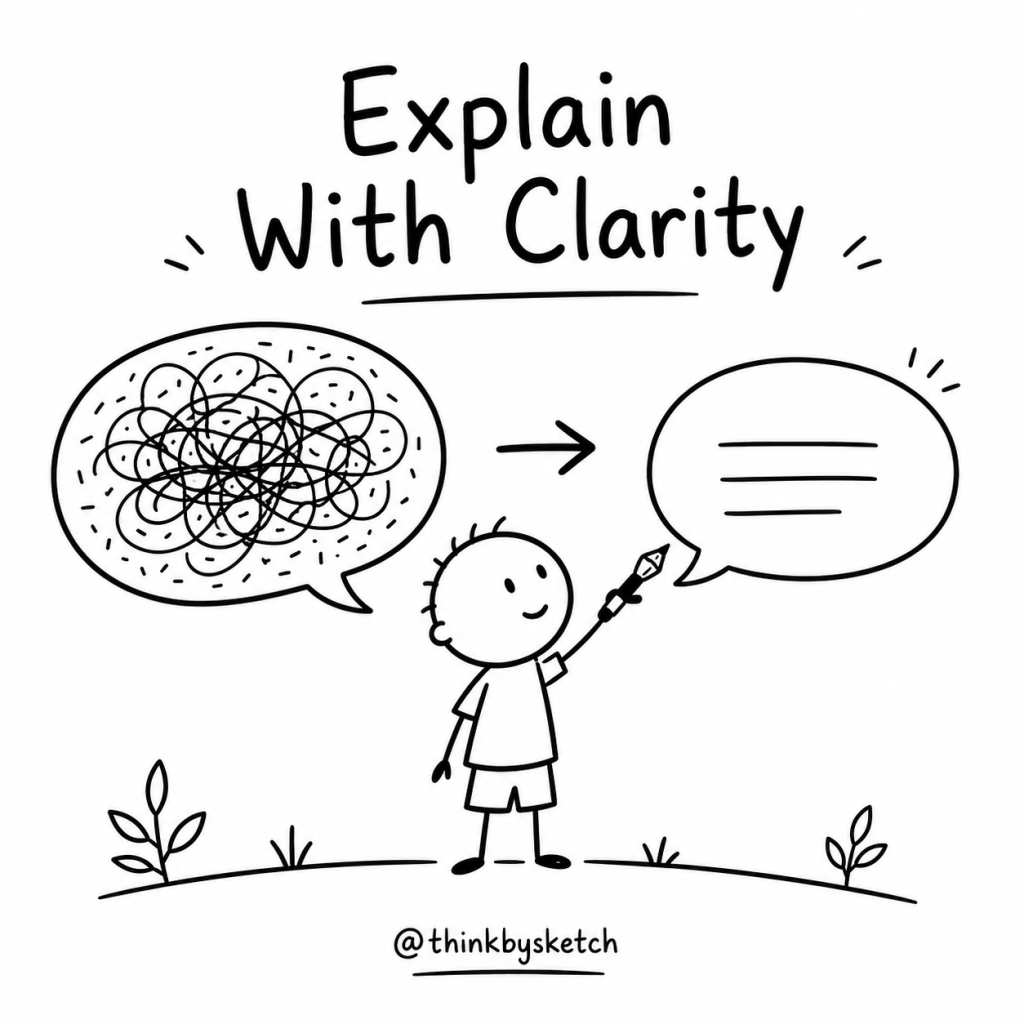
When an explanation is confusing, children often add more words.
The result becomes longer without becoming clearer.
Clarity is not mainly about speaking less. It is about deciding what the listener needs in order to follow the idea.
Start with the one thing the listener should understand
Before explaining, ask the child to finish this sentence:
“After I explain this, I want the listener to understand…”
This creates a destination. Without it, every interesting detail competes for attention.
Use a three-part explanation
Many ideas become easier to follow when organised into:
- The idea: What is it?
- The mechanism: How or why does it work?
- The example: Where can we see it?
For example:
“Evaporation is when liquid water becomes water vapour. Heat gives some water particles enough energy to leave the liquid. A wet shirt drying in the sun is an example.”
The structure is simple, but it still protects the important reasoning.
Remove details that do not change understanding
Ask the child to mark every sentence as one of three types:
- Essential: The idea breaks without it.
- Helpful: It supports understanding.
- Interesting: It is related but not needed yet.
Keep the essential details. Add helpful details where the listener may get stuck. Save interesting details for a follow-up question.
Use a sketch to expose gaps
Ask the child to draw the explanation using shapes, arrows and labels.
If they cannot decide what connects to what, the verbal explanation may also be hiding a gap.
A sketch is useful because it forces choices:
- What comes first?
- What causes the change?
- What belongs together?
- What can be left out?
Check clarity with the listener
The speaker is not the best judge of whether an explanation worked. They already know what they intended to say.
After listening, ask the other person to explain the idea back in their own words.
Then compare:
- What survived?
- What became distorted?
- Where did the listener need to guess?
This gives the child feedback about the explanation, not about their intelligence.
Try the 30-second, 10-second and sketch challenge
Choose one familiar concept.
- Explain it in 30 seconds.
- Explain it in 10 seconds.
- Explain it with one sketch and five words.
After each version, ask what was lost and whether the loss mattered.
The shortest version is not automatically the best.
The best version gives this listener enough structure to understand the idea without making them carry unnecessary noise.
 ThinkBySketch
Leave a comment