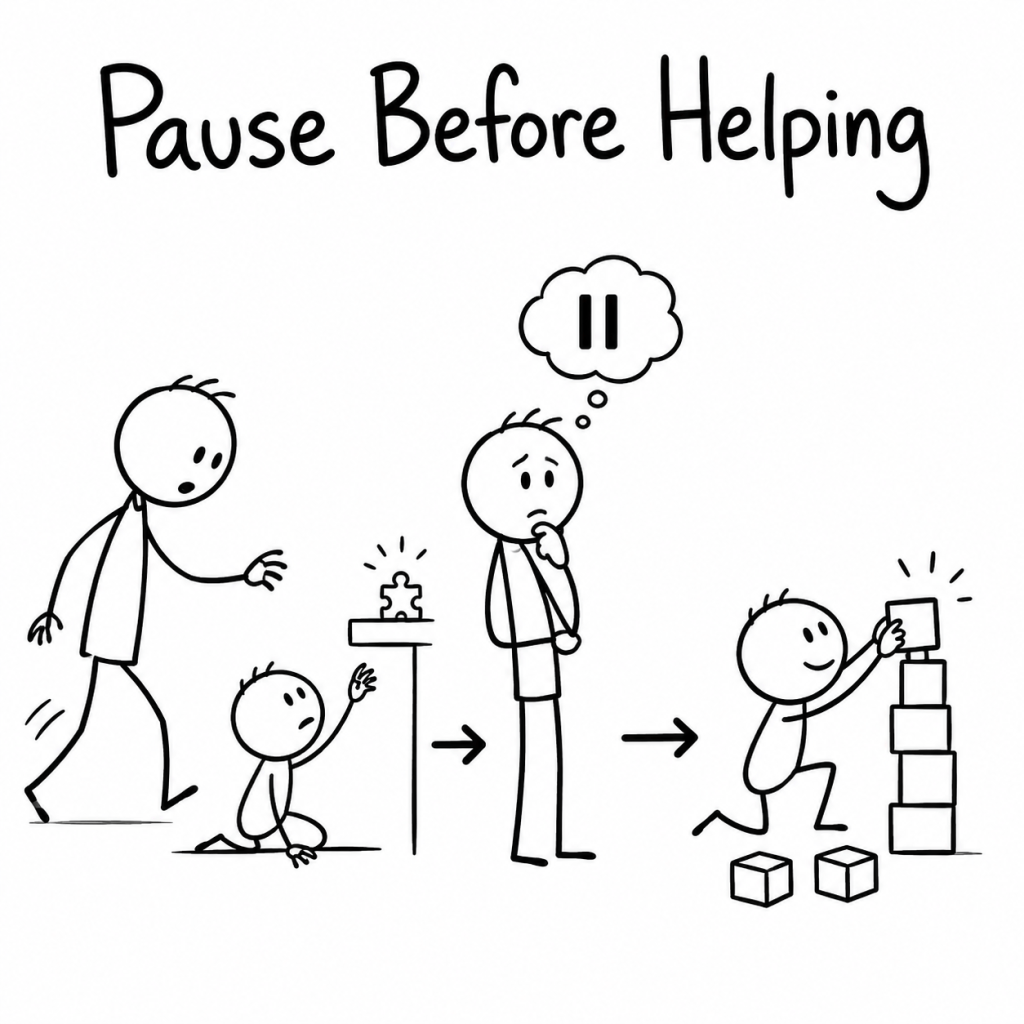
Helping a child quickly can solve the immediate problem.
It can also remove the part they needed to practise.
This tension appears in ordinary moments. A child cannot open a container. They forget part of a school task. They disagree with a friend. They are building something that keeps falling apart.
The adult can often fix the situation faster. The harder question is whether speed is the most useful goal.
Protection, guidance and rescue are different
Some situations require immediate adult action. Safety, health, bullying and risks beyond a child’s ability should not become experiments in independence.
Other situations leave room for an attempt.
- Protection removes a serious risk.
- Guidance gives the child enough support to continue.
- Rescue completes a manageable task before the child can engage with it.
The same action can fall into different categories depending on the child, the context and the consequence of failure.
Use a three-question pause
Before stepping in, ask:
- Is this unsafe or simply uncomfortable?
- What part can the child reasonably try?
- What is the smallest help that keeps them moving?
The smallest help might be a question, a demonstration of one step or a reminder of something they tried before.
“Show me where you got stuck.”
That sentence keeps the child inside the problem. It also helps the adult see whether the difficulty is confusion, missing knowledge, frustration or tiredness.
Do not confuse independence with being left alone
A child can attempt something independently while an adult remains available.
Useful support might sound like:
- “Try one idea first. I am here if it does not work.”
- “Would you like a hint or another minute?”
- “Which part do you want to do and which part needs help?”
- “What did the failed attempt teach you?”
This gives a child both agency and a safety net.
Let the consequence match the lesson
Not every mistake needs to be prevented. Not every mistake should be allowed either.
For a low-stakes task, a missed step may create useful feedback. For a high-stakes situation, the adult may need to take control and explain the reasoning afterward.
The decision rule is not “never help.” It is:
Do not remove a useful attempt merely because you can finish it faster.
A small experiment for this week
Choose one recurring task that you usually take over.
Break it into three parts:
- What the child can do alone
- What they can do with a prompt
- What still requires adult help
Then adjust the support one step at a time.
The aim is not to produce a perfectly independent child.
It is to help them experience the next piece of thinking, choosing or doing that they are ready to practise.
 ThinkBySketch
Leave a comment