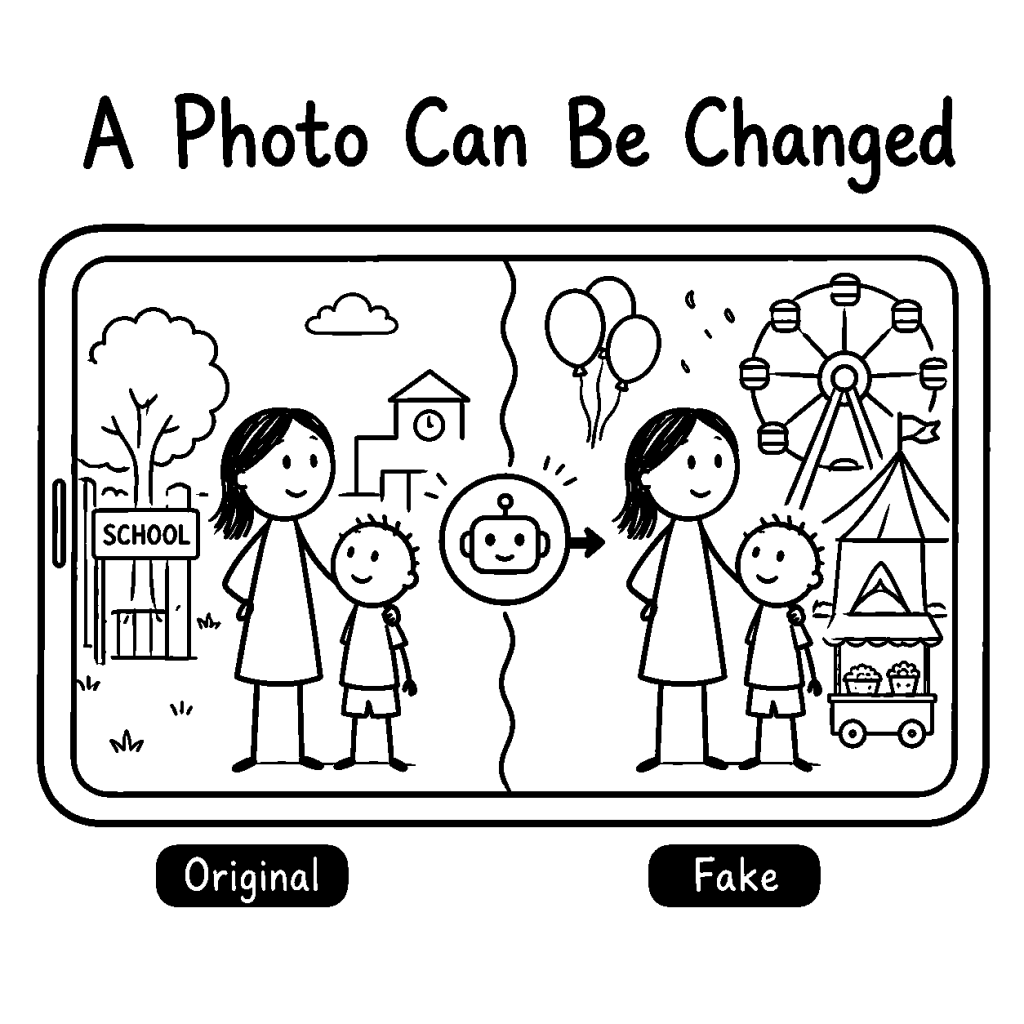
The uncomfortable part of AI image safety is this: a child does not need to take or send an explicit photo for an explicit fake to exist.
An ordinary selfie, team photo or school picture can become raw material for someone to create a convincing fake.
That changes a parenting rule many of us grew up with.
For years, the advice was mostly: think before you post because the internet remembers.
That is still useful. But AI adds another question:
What could someone else make this photo appear to be?
This is not a reason to panic or stop sharing every family photo. It is a reason to teach children a new kind of digital judgment.
The risk is real, but fear is a poor teacher
In February 2026, UNICEF warned about AI-generated sexualised images of children. In a study across 11 countries, at least 1.2 million children reported that images of them had been manipulated into sexually explicit deepfakes in the previous year.
The UK Internet Watch Foundation also reported that 21% of reports made through its Report Remove service in 2025 involved faked imagery.
The useful lesson is not “never put a photo online again.” That sounds safe, but it gives families a rule that is difficult to apply and easy to abandon.
A better goal is to help children understand three things:
- a digital image can be copied and changed
- a convincing image is not automatically evidence
- if something harmful happens, the child should know what to do next
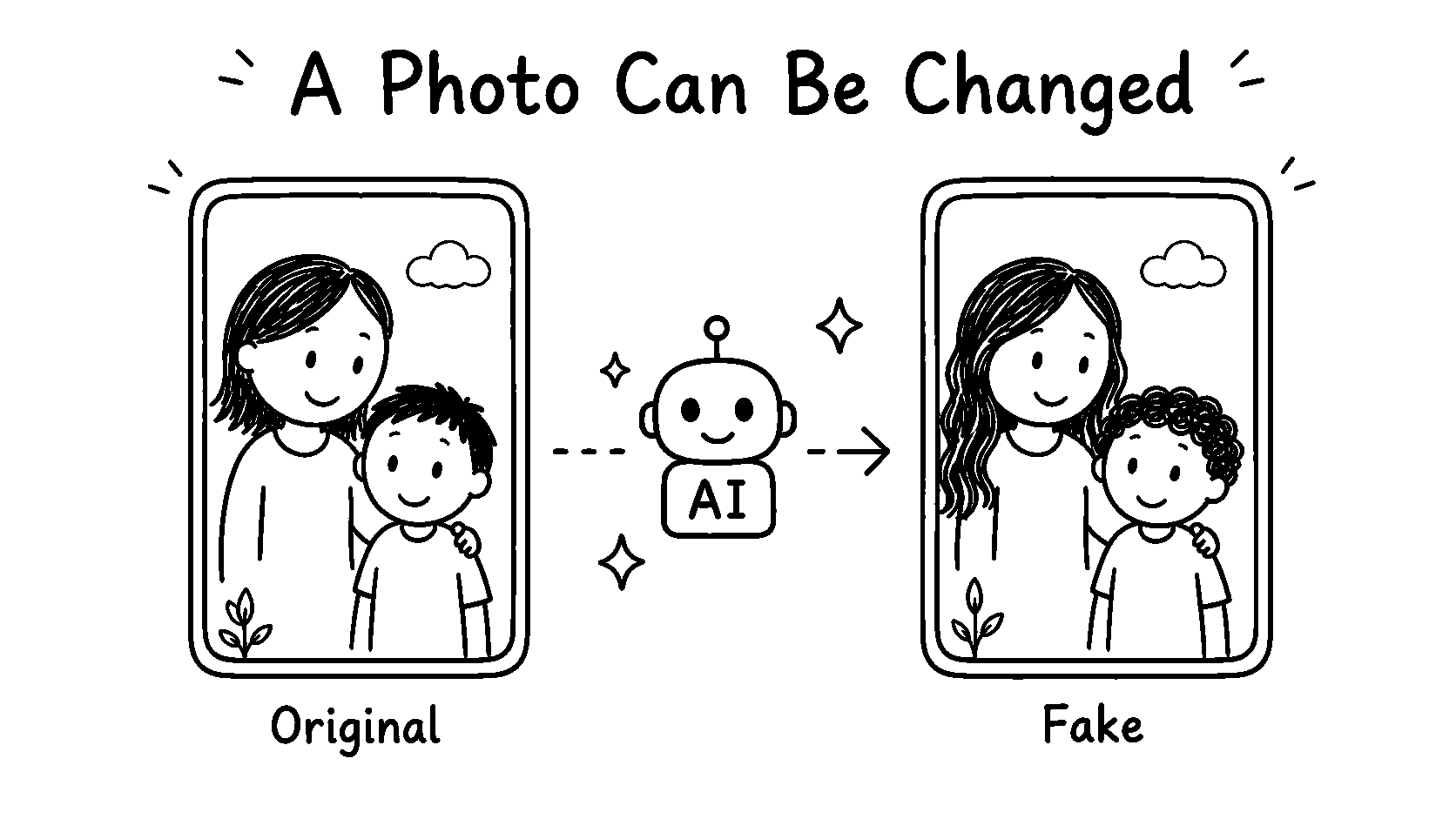
That moves the conversation from fear to capability.
Before sharing a photo, ask four questions
We cannot make every image impossible to misuse. We can reduce unnecessary exposure.
Before posting or sharing a photo of a child, I find these four questions more useful than a blanket rule.
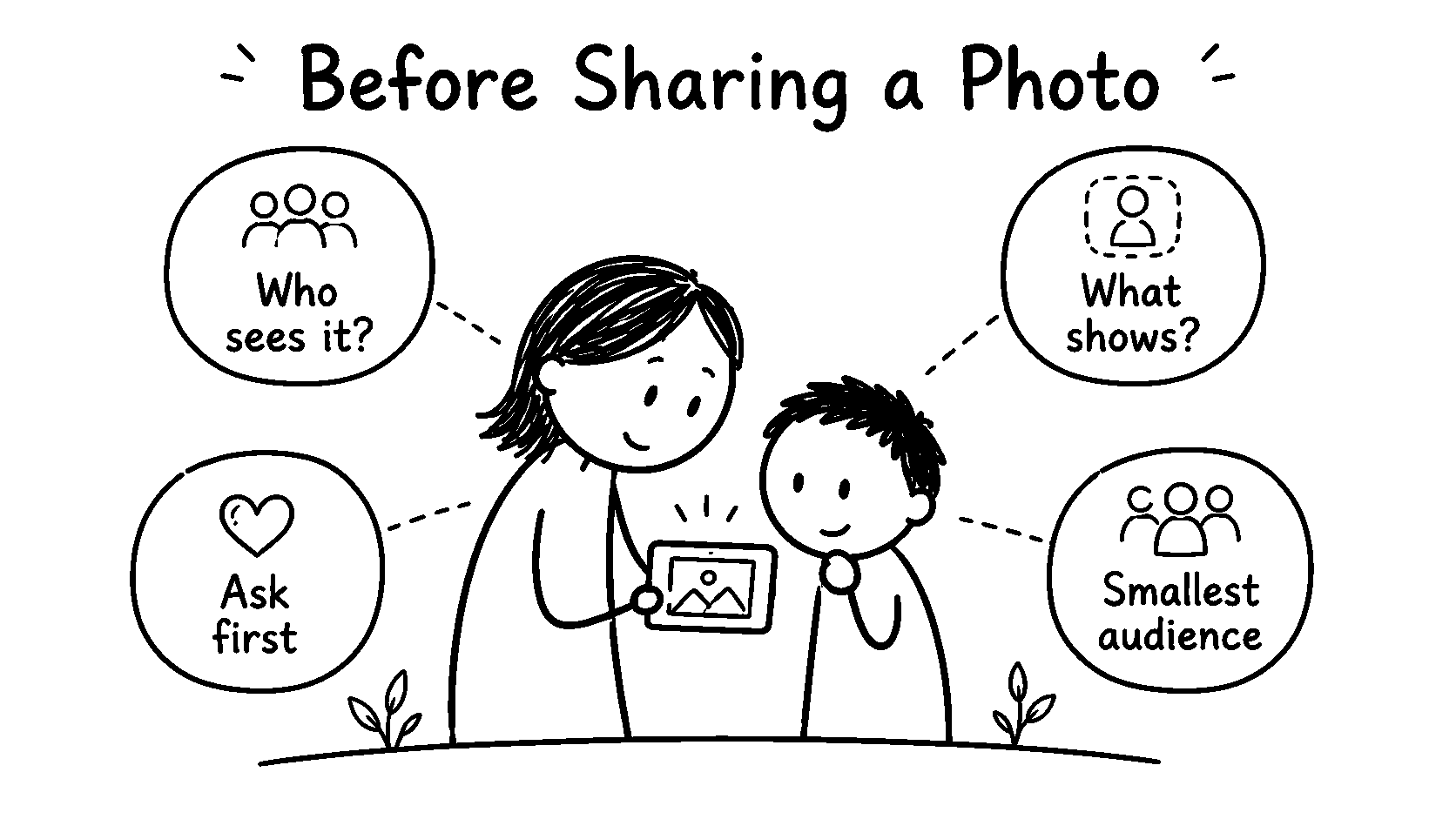
1. Who can actually see this?
There is a meaningful difference between sharing with a small private group and publishing to an open account.
The question is not only “am I comfortable posting this?” It is “does this need to be public?”
2. What else does the image reveal?
A photo may accidentally expose more than a face.
- a school name on a uniform
- a sports club or class schedule
- a location or regular route
- a full name on a badge
- details in the background that identify where a child spends time
Removing unnecessary context does not eliminate risk. It simply gives strangers less information to combine.
3. Does the child want this shared?
Consent is useful long before a child is old enough to understand every technical risk.
Asking “are you okay if I share this with the family group?” teaches that images of people are not just content. They belong to a relationship.
The same rule can extend to children using AI tools. Before editing a friend’s face, generating a joke image or uploading someone else’s photo to an AI service, ask first.
4. What is the smallest audience that still serves the purpose?
This is a useful engineering-style question.
If a grandparent needs to see a photo, the whole internet does not need access to it. If a school project needs an image, it may not need a child’s full name, location and face together.
Privacy becomes easier when we stop treating every decision as public versus secret and start choosing the smallest useful audience.
Teach children that “looks real” is no longer enough
Deepfakes create a second problem beyond privacy.
Children are growing up in a world where a picture, voice recording or video can look authentic while being partly or completely fabricated. So “I saw the picture” cannot be the end of the reasoning. When an image matters, teach a short verification habit:
- Source: Who posted it first?
- Context: What claim is being made about the image?
- Confirmation: Is there another reliable source showing the same event?
- Pressure: Is someone using the image to embarrass, threaten or rush you into acting?
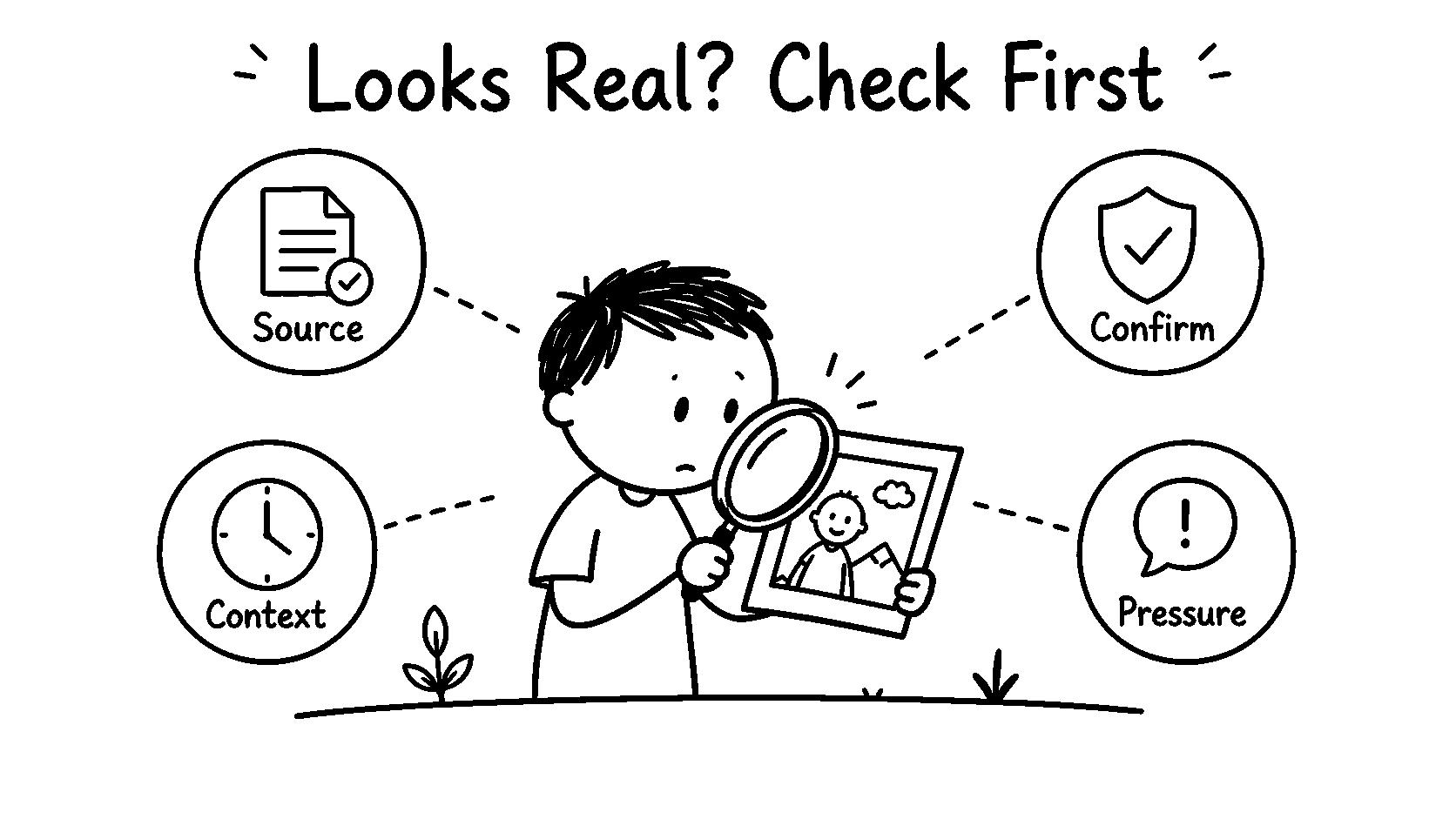
This is broader than deepfake detection. It is a media literacy habit that still works when detection tools are imperfect.
Give children a response plan before they need it
The most important conversation may not be about preventing every fake.
It may be about what happens if one appears.
A child who receives a humiliating or sexualised fake may worry that an adult will confiscate the phone, blame them for posting photos or turn the situation into an interrogation.
That fear can delay the one thing we want most: telling a trusted adult quickly.
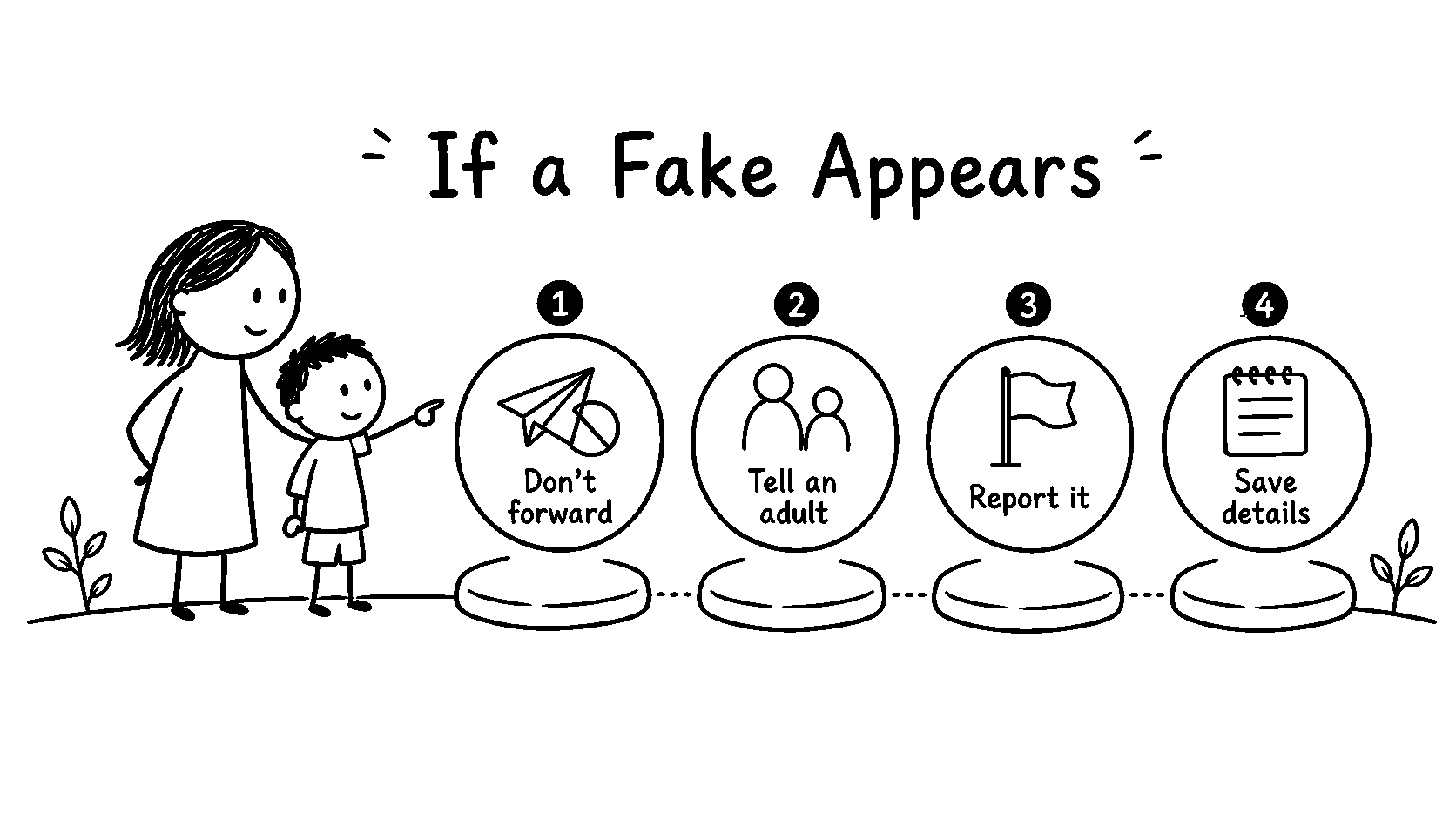
I would teach a simple response:
- Do not forward it. Resharing can increase the harm.
- Tell a trusted adult. Do this even if you are embarrassed or unsure whether the image is real.
- Use the platform’s reporting tools. Follow official reporting instructions before downloading or copying harmful content.
- Record useful details. Account names, links, timestamps and where the content appeared may matter when making a report.
For sexually explicit images involving someone who was under 18, official child-safety services can also help. NCMEC’s Take It Down is a free service designed to help limit the online spread of nude, partially nude or sexually explicit images or videos of people who were under 18. The IWF and Childline Report Remove service provides a similar child-centred reporting route in the UK.
The exact reporting route depends on the country and platform. The family principle can stay simple:
If someone creates something fake or harmful about you, come to me first. We will work out the next step together.
Do not turn this into a surveillance project
Parents will not see every AI interaction a child has.
That is already visible in the research. A 2026 Family Online Safety Institute survey of more than 4,000 families in the US and Australia found that 27% of parents said their child had used generative AI in the previous week, while 38% of children said they had.
That gap matters because a safety plan built entirely on monitoring will always have blind spots.
The more durable skill is judgment.
Can a child notice when an image is trying to manipulate them? Can they pause before forwarding it? Can they protect someone else’s image as carefully as their own? Can they ask for help before a problem grows?
Those habits still work when the next AI tool looks completely different from today’s.
Try this 10-minute family exercise
Pick an ordinary, non-sensitive photo together. It can be a public image rather than a personal family photo.
Ask:
- What can we know from this image?
- What are we only assuming?
- What details could identify the person or place?
- How could someone change the meaning without changing the whole image?
- If a strange version of this appeared in a group chat, what would we do before sharing it?
The goal is not to make children suspicious of every picture.
The goal is to make verification feel normal.
The new rule is bigger than “think before you post”
AI literacy is not only about learning how to prompt, generate or build with AI. It is also learning what digital evidence can and cannot prove. Children need to know that images can be useful without being unquestionable, shareable without needing to be public and harmful even when they are fake.
The old rule was:
Think before you post.
The AI-era version is:
Think before you expose, trust or share.
That is a skill children can carry into whatever comes next.
Sources and further reading
- UNICEF: “Deepfake abuse is abuse”
- UNICEF Innocenti: Snapshot of AI Usage and Concerns Among Children and Parents
- Family Online Safety Institute: Parents Are Underestimating Their Kids’ Digital Lives
- Internet Watch Foundation: Report Remove Data
- National Center for Missing & Exploited Children: Take It Down


Leave a comment