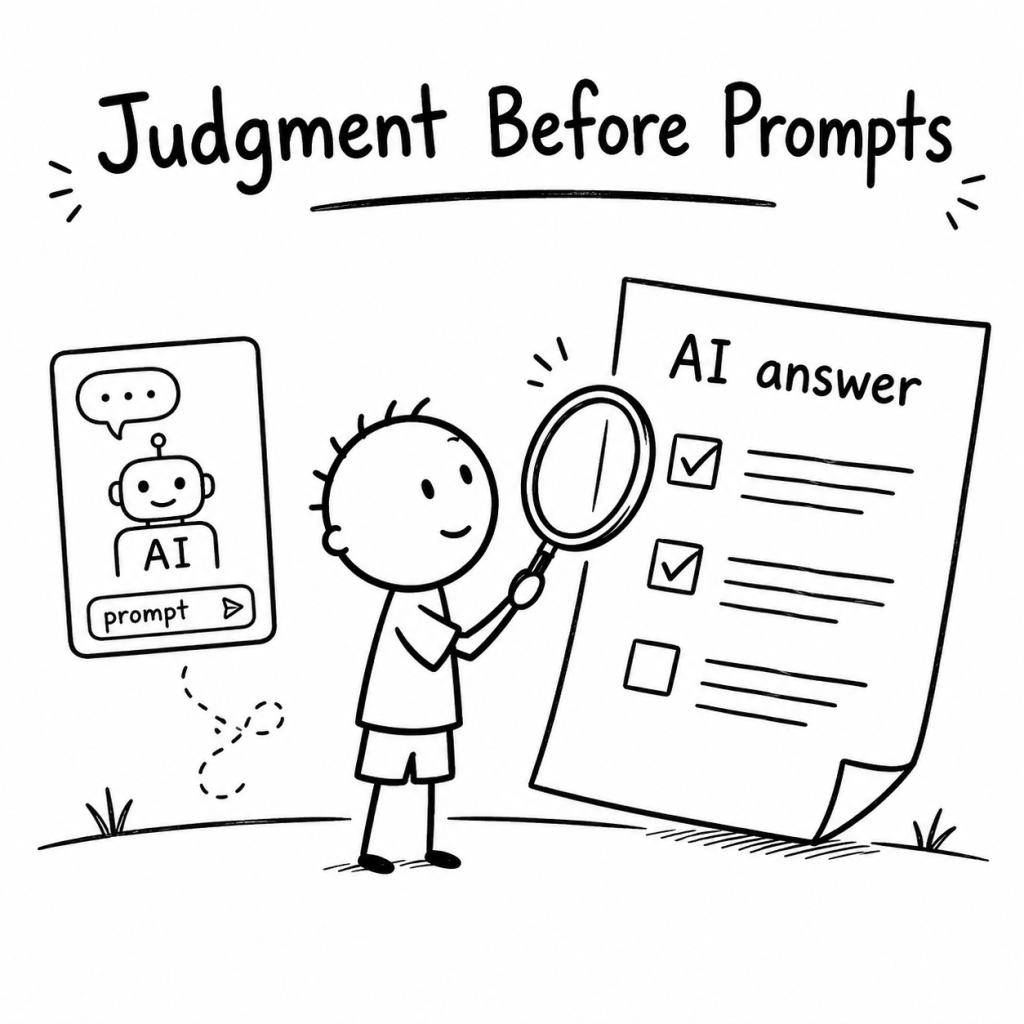
We are teaching children to get better answers from machines before teaching them how to decide whether those answers deserve trust.
That feels backwards.
There is growing enthusiasm around teaching children how to write better AI prompts. Be specific. Give the AI a role. Add context. Ask better follow-up questions.
Those are useful techniques. But I do not think they should be the foundation of AI literacy for children.
The first skill should be judgment. Not prompting.
A good prompt can hide weak thinking
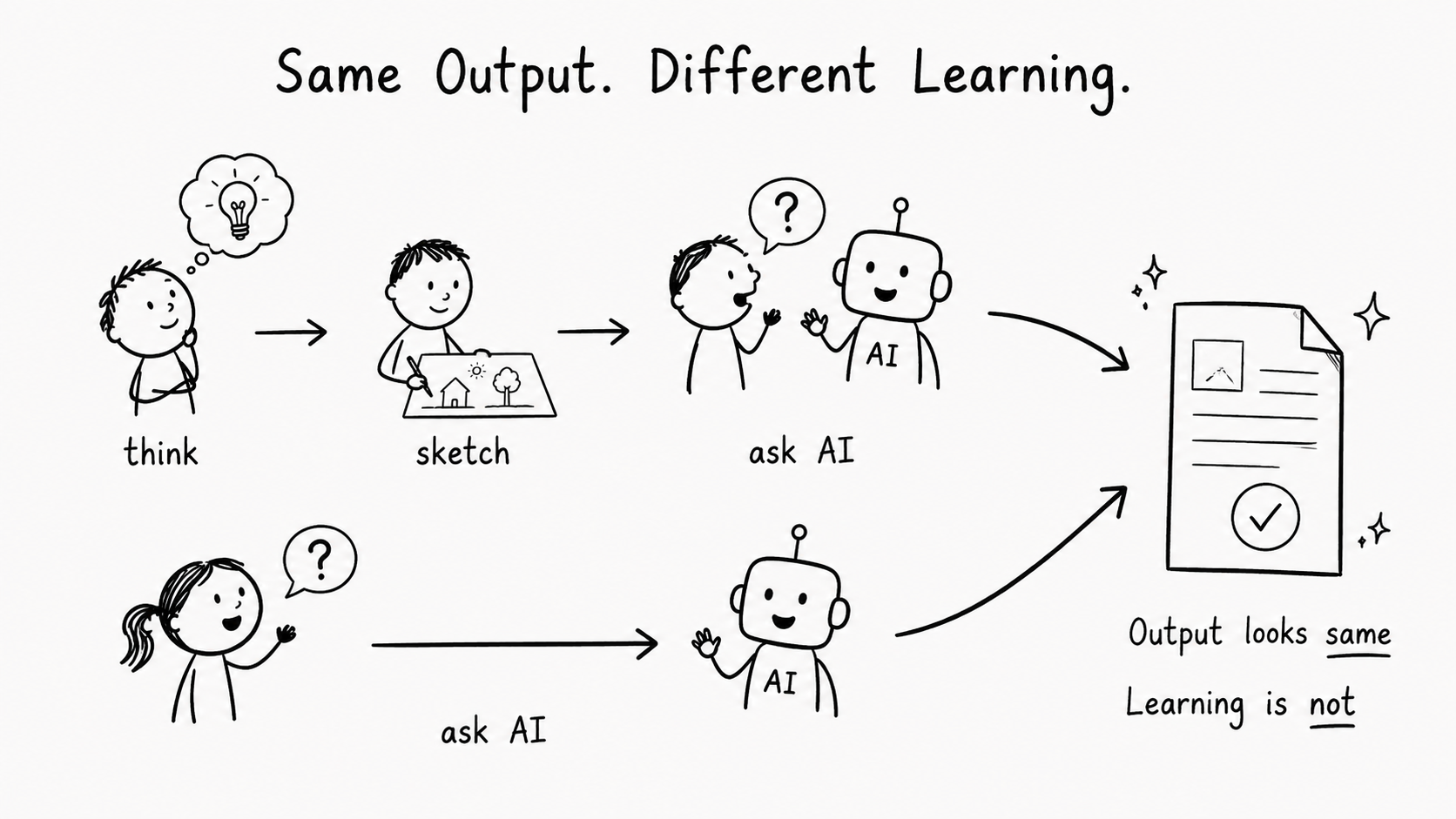
Imagine two children working on the same question.
One struggles first. They make a guess, sketch an idea, notice what they do not understand and then ask AI for help.
The other asks AI to solve it immediately.
Both may end up with an excellent answer. The output can look almost identical. The learning process is not.
That matters because AI makes the final artifact a weaker signal of understanding. A polished paragraph no longer tells us how much thinking happened. A beautiful presentation does not tell us who formed the argument. Correct code does not tell us whether the child understands why it works.
The better AI becomes, the less reliable output quality becomes as evidence of understanding.
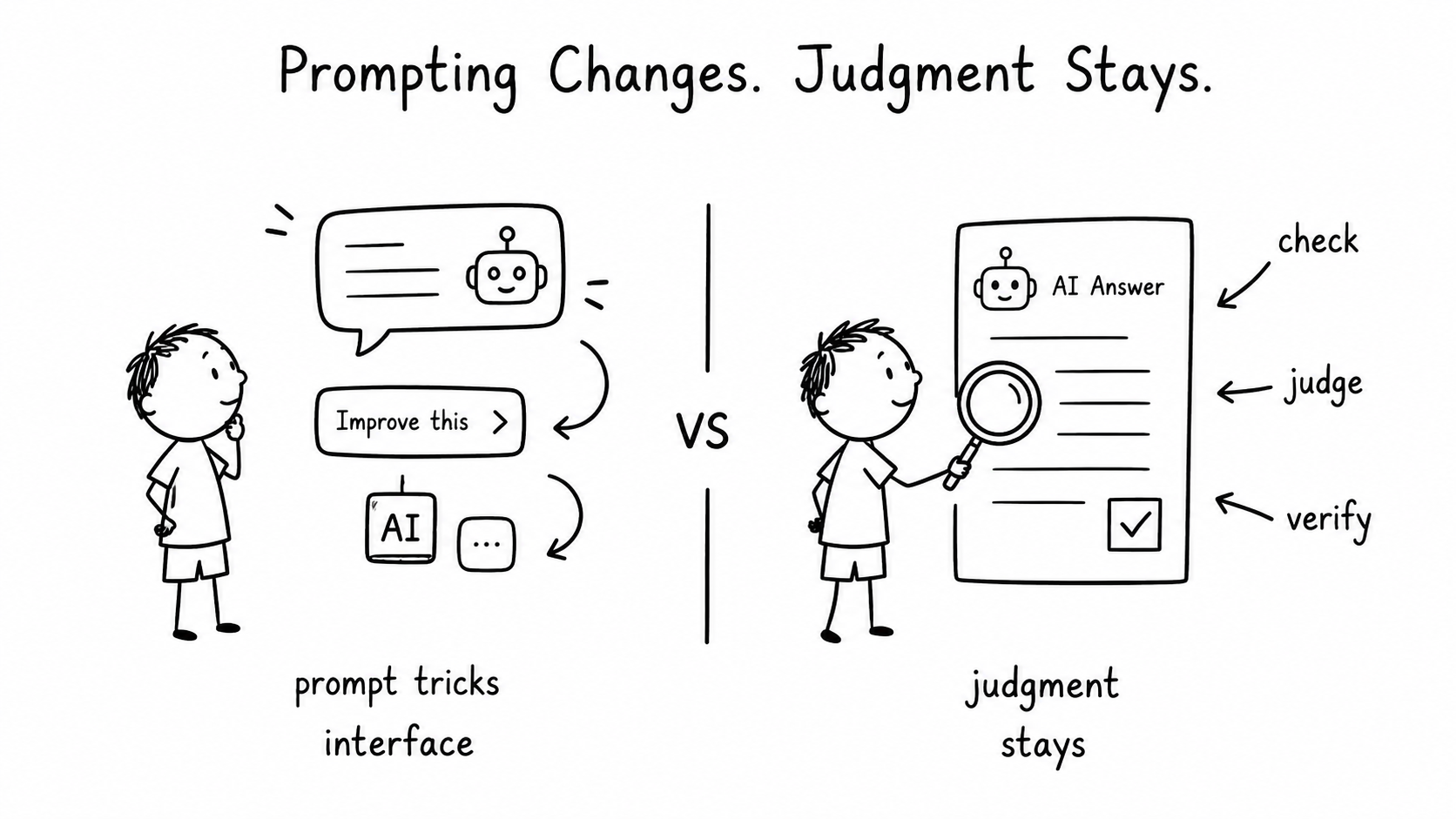
Prompting is useful. It is also an interface skill.
There is nothing wrong with learning to communicate clearly with an AI system. Children will benefit from giving context, defining constraints and asking useful follow-up questions.
But interfaces change quickly. Today’s prompt techniques may become tomorrow’s invisible defaults.
The durable skill is not knowing the perfect sentence to type into a chatbot. It is knowing what you are trying to accomplish, noticing when an answer feels incomplete, separating fact from assumption and deciding when not to use AI at all.
That is judgment.
The real question is what effort AI removes
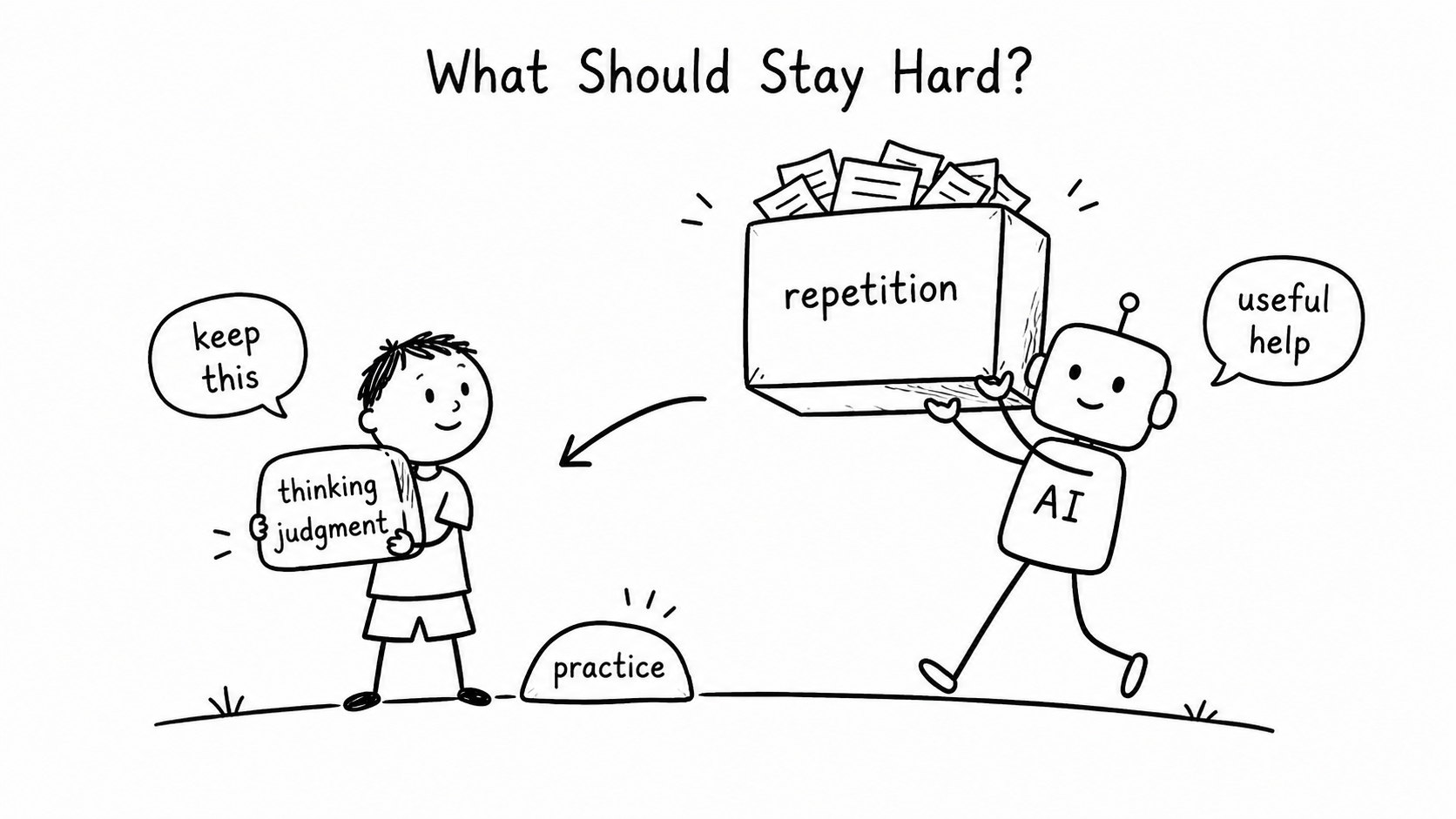
I would avoid saying AI makes children lazy. Children have always used tools to reduce effort. Calculators reduce arithmetic effort. Search engines reduce lookup effort. Spellcheck reduces proofreading effort.
Reducing effort is often exactly what a good tool should do.
The better question is:
Which effort are we removing?
If AI removes repetitive effort so a child can investigate a deeper question, that may be useful. If AI removes the exact mental work the child is supposed to practise, that is different.
So instead of asking, “Did AI make this easier?” I would ask, “What became easier, and was that the part the child needed to practise?”
That is a much better test.
Teach four questions before ten prompting tricks
Before teaching a child a library of prompt formulas, I would rather teach four habits.
1. What do I already know?
Ask the child to form an initial thought before opening the chatbot. It can be incomplete or wrong. The point is to give their own thinking somewhere to start.
2. What is the AI assuming?
AI answers can sound complete while hiding important assumptions. Teach children to look for them.
3. What could be wrong here?
Not because every AI answer is suspicious. Because confidence and correctness are different things.
4. How could I check it?
Use another source. Try an example. Run the code. Calculate independently. Ask someone who knows the subject. Compare two explanations.
These questions turn AI from an answer machine into something closer to a thinking partner.
There is a better sequence
Instead of:
Ask → Accept → Submit
I would teach:
Think → Ask → Check → Revise
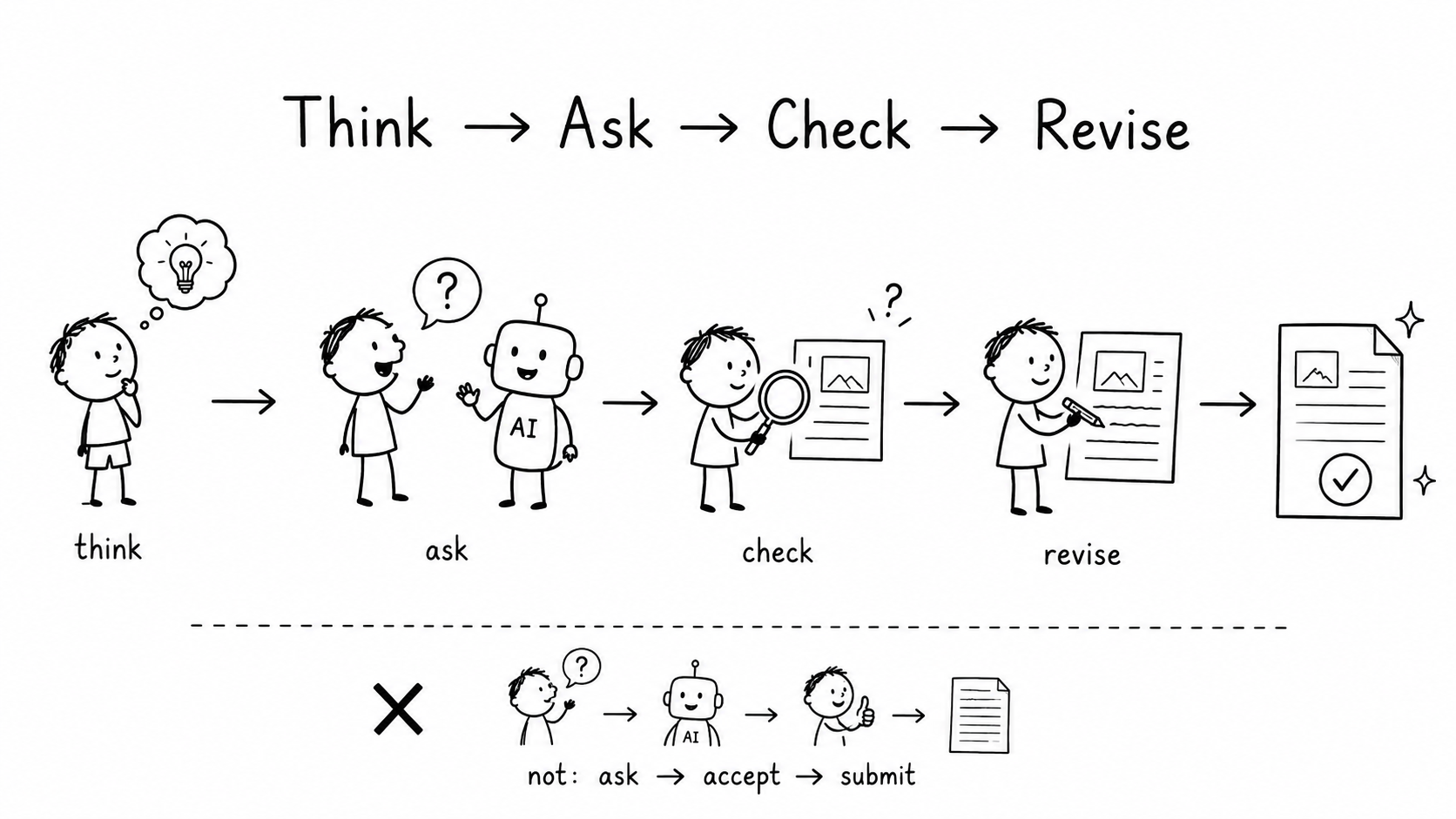
The difference looks small, but it changes the child’s role.
In the first sequence, AI owns most of the intellectual process. In the second, the child remains responsible for the goal, the evaluation and the final decision.
That responsibility is the skill I want children to keep.
A simple experiment for parents
The next time your child wants to use AI for homework or a project, do not begin by improving their prompt.
Start with:
Before we ask AI, what do you think?
Let them sketch, explain or make a rough prediction. Then use AI.
After the response appears, ask:
- What did it notice that you missed?
- What might it have missed?
- What would you change before this becomes your answer?
That small shift changes the lesson. The child is no longer practising how to obtain an answer. They are practising how to evaluate one.
The AI skill that survives better AI
Prompting will matter. But as AI systems get better at understanding vague requests and anticipating what people want, clever prompting techniques may matter less.
Judgment moves in the opposite direction.
The more fluent and convincing AI becomes, the more important it becomes to know when to question it.
So I would teach children to use AI. I would teach them how to prompt it too.
I just would not start there.
The first AI skill is not knowing what to ask the machine.
It is knowing what to do with the answer.

